Question
What is activation energy? Explain with the help of graph by suitable example

Answer

$\rightarrow$ Activation energy can be understood clearly using the formation reaction of hydrogen iodide.
$\rightarrow H2(g) + I2(g)$
$\rightarrow 2HI(g)$
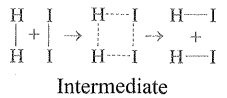
$\rightarrow$ According to Arrhenius, this reaction can take place only when a molecule hydrogen and molecule of iodine collide to form an unstable intermediate. It exists for a very short time and then breaks up to form two molecules of hydrogen iodide.
Image
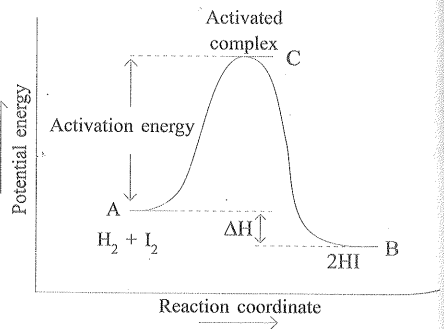
$\rightarrow$ The energy required to form this intermediate, called activated complex $(C),$ is known as activation energy $(E_a).$
$\rightarrow$ Below figure is obtained by plotting potential energy $VS$ reaction coordinate. Reaction coordinate represents the profile of energy change when reactant change into products.
Image
$\rightarrow$ Some energy is released when the complex decomposes to form products. So, the final enthalpy of the reaction depends upon the nature of reactants and products.

Need a full question paper?

Generate a complete, print-ready paper with questions like this in minutes — across 16+ boards, with answer keys.
Start Generating Free

Similar questions

Depict the galvanic cell in which the reaction $Zn(s) + 2Ag^+(aq) → Zn^{2+}(aq) + 2Ag(s)$ takes place. Further show:
  1. Which of the electrode is negatively charged?
  2. The carriers of the current in the cell.
  3. Individual reaction at each electrode.
Account for the following:
  1. $PCl_5$ is more covalent than $PCl_3.$
  2. Iron on reaction with HCl forms $FeCl_2$ and not $FeCl_3$
  3. The two $O-O$ bond lengths in the ozone molecule are equal.
State Kohlrausch's law of independent migration of ions. How can the degree of dissociation of acetic acid in a solution be calculated from its molar conductivity data?
Complete the following chemical equations:
  1. $\mathrm{Cr}_2 \mathrm{O}_7{ }^{2-}+6 \mathrm{Fe}^{2+}+14 \mathrm{H}^{+} \rightarrow$
  2. $2 \mathrm{CrO}_4^{2-}+2 \mathrm{H}^{+} \rightarrow$
  3. $2 \mathrm{MnO}_4^{-}+5 \mathrm{C}_2 \mathrm{O}_4{ }^{2-}+16 \mathrm{H}^{+} \rightarrow$
Write short note on tetra chloromethane $(CCL_4) \#\#\#$ Write short note on Carbon tetra chloride.
Give reasons:
  1. $SO_2$ is reducing while $TeO_2$ is an oxidizing agent.
  2. Nitrogen does not form pentahalide.
  3. $ICl$ is more reactive than $I_2.$
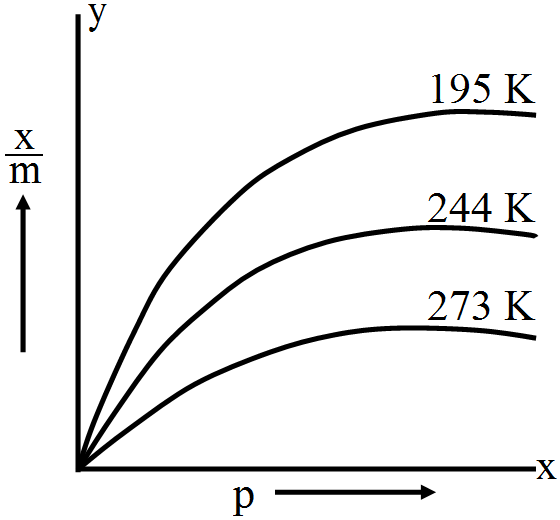
Consider the adsorption isotherms given alongside and interpret the variation in the extent of adsorption $\Big(\frac{\text{x}}{\text{m}}\Big)$ when:
  1.  
  1. Temperature increases at constant pressure.
  2. Pressure increases at constant temperature.
  1. Name the catalyst and the promoter used in Haber’s process for manufacture of ammonia.
  1. Using valence bond theory predict the geometry and magnetic behaviour of $[Cr(NH_3)_6]^{3+}ion[Cr=24].$
  2. Write IUPAC name of:
$[Pt(NH_3)_2Cl_2].$
Explain the following observations:
There is a close similarity in physical and chemical properties of the 4d and 5d series of the transition elements, much more than expected on the basis of usual family relationship.
Give reasons for the following:
  1. Transition metals form alloys.
  2. $Mn_2O_3$ is basic whereas $Mn_2O_7$ is acidic.
  3. $Eu^{2+}$ is a strong reducing agent.