Question
What is activation energy? Explain with the help of graph by suitable example

Answer

$\rightarrow$ Activation energy can be understood clearly using the formation reaction of hydrogen iodide.
$\ce{\rightarrow H2(g) + I2(g) \rightarrow 2HI(g)}$
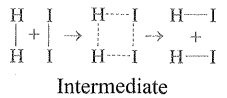
$\rightarrow$ According to Arrhenius, this reaction can take place only when a molecule hydrogen and molecule of iodine collide to form an unstable intermediate. It exists for a very short time and then breaks up to form two molecules of hydrogen iodide.
Image
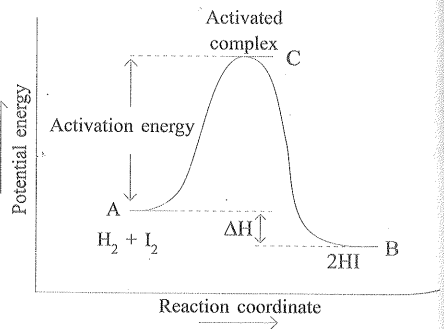
$\rightarrow$ The energy required to form this intermediate, called activated complex $(C),$ is known as activation energy $(E_a).$
$\rightarrow$ Below figure is obtained by plotting potential energy $VS$ reaction coordinate.
Reaction coordinate represents the profile of energy change when reactant change into products.
Image
$\rightarrow$ Some energy is released when the complex decomposes to form products.
So, the final enthalpy of the reaction depends upon the nature of reactants and products.

Need a full question paper?

Generate a complete, print-ready paper with questions like this in minutes — across 16+ boards, with answer keys.
Start Generating Free

Similar questions

Write the structures of fragments produced on complete hydrolysis of DNA. How are they linked in DNA molecule? Draw a diagram to show pairing of nucleotide bases in double helix of DNA.
What is meant by crystal field splitting energy? On the basis of crystal field theory, write the electronic configuration of $d^4$ in terms of $t_{2g}$ and $e_{g }$ in an octahedral field when
  1. $\triangle _0>P$
  2. $\triangle _0$
Determine the osmatic pressure of a solution prepared by dissolving $2.5\times 10^{-2}g$ of $K_2SO_4$ in $2L$ of water at $25^\circ\ C,$ assuming that it is completely dissociated.$(R=0.0821\ L$ atm $K^{-1} \text{mol}^{-1},$ Molar mass of $K_2SO_4=174\  g\  \text{moi}^{-1}).$
Write all the possible isomers of $\ce{[Co(NH_3)_5(SCN)]Cl}.$
A green solution of potassium manganate turns purple when $CO_2$ gas is passed through the solution.
Account for the following:
  1. $CuCl_2$ is more stable than $Cu_2Cl_2.$
  2. Atomic radii of $4d$ and $5d$ series elements are nearly same.
  3. Hydrochloric acid is not used in permanganate titrations.
Explain the following reaction of $C _2 H _5 OH$ :
(a) Schotten Baumann reaction
(b) Reaction with concen. $HNO _3$
(c) Reaction with excess of $NH _3$
(d) Reduction with Red P and HI
Give the oxidation state, d-orbital occupation and coordination number of the central metal ion in the following complexes : 
(i) $K _3\left[ Co \left( C _2 O _4\right)_3\right]$
(ii) cis - $\left[ Cr ( en )_2 Cl _2\right] Cl$
(iii) $\left( NH _4\right)_2\left[ CoF _4\right]$
(iv) $\left[ Mn \left( H _2 O \right)_6\right] SO _4$
Describe for any two of the following complex ions, the type of hybridization, shape and magnetic property$:$
  1. $\ce{[Fe(H_2O_6)]^{2+}}$
  2. $\ce{[Co(NH_3)_6]^{3+}}$
  3. $\ce{[NiCl_4]^{2-}}$
$($At. Nos. $\ce{Fe = 26, Co = 27, Ni = 28)}.$
A 4% solution (w/w) of sucrose (M = 342 g $ mol^{-1} $) in water has a freezing point of 271.15 K. Calculate the freezing point of 5% glucose (M = 180 g $ mol^{-1} $) in water. (Given: Freezing point of pure water = 273.15 K)