Question
What is adsorption isotherm? Explain about Freundlich adsorption isotherm.

Answer

1. Adsorption isotherms represents the variation of adsorption at constant temperature.
Adsorption isoterm can be studied quantitatively.
2. A plot between the amount of adsorbate adsorbed and pressure or concentration of adsorbate at constant temperature is called adsorption isotherms.
3. Freundlich adsorption isotherm. According to Freundlich $\frac{ x }{ m }= kP ^{1 / n }$
Where $x$ is the amount of adsorbate (or) adsorbed on ' $m$ ' $gm$ of adsorbent at a pressure of P. $k$ and $n$ are constants. Value of' $n$ ' is always less than unity.
4. This equation is applicable for adsorption of gases on solid surfaces. The Same equation becomes $\frac{ x }{ m }= kc ^{1 / n }$ when used for adsorption in solutions with ' $c ^{\prime}$ as concentration.
5. These equation quantitatively predict the effect of pressure (or concentration) on the adsorption of gases (or adsorbates) at constant temperature.
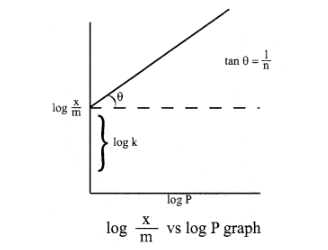
6. Taking log on both sides of equation
$\frac{ x }{ m }= kP ^{1 / n }$
$\log \frac{x}{m}=\log k +\frac{1}{n} \log P$

Image
7. Hence the intercept represents the value of log $k$ and the slope $\frac{b}{q}$ gives $\frac{1}{n}$
8. This equation explains the increase of with increase in pressure. But experimental values shows the deviation at low pressure.
9. Limitations:
1. This equation is purely empirical and valid over a limited pressure range.
2. The value of $k$ and $n$ also found vary with temperatures. No theoretical explanations were given.
 

Need a full question paper?

Generate a complete, print-ready paper with questions like this in minutes — across 16+ boards, with answer keys.
Start Generating Free

Similar questions

Indicate the types of isomerism exhibited by the following complexes and draw the structures for these isomers:
1. $K \left[ Cr \left( H _2 O \right)_2\left( C _2 O _4\right)_2\right]$
2. $\left[ CO ( NH )_3 Cl \right] Cl _2$
3. $K _3\left[ Fe ( CN )_6\right]$
4. $K _3\left[ Fe \left( C _2 O _4\right)_3\right]$
5. $K _2\left[ PdCl _4\right]$
6. $\left[ Pt \left( NH _3\right)_2 Cl \left( NH _2 CH _3\right)\right] Cl$
An organic compound (A) of molecular formula $C _6 HN _2 Cl$ on boiling with hot water gives (B) of molecular formula $C _6 H _6 O$. (B) on reaction with Zinc dust gives $(C)$ a simplest aromatic hydrocarbon. (C) on reaction with methyl chloride in the presence of anhydrous $AlCl _2$ gives (D) of molecular formula $C _7 H _8$. Identify A, B, C, D and explain the reaction.
An organic compound $(A)$ of molecular formula $C _2 H _6 O$ reacts with metallic Na and liberates $H _2$ gas. (A) on mild oxidation with Cu at 573 K gives (B) of molecular formula $C _2 H _4 O$. (B) on reaction with methyl magnesium bromide followed by acid hydrolysis gives (C) of molecular formula $C _3 H _5 O$. (C) gives Blue colour in Victor Meyer's test. (C) on mild oxidation with Cu at 573 K gives (D) of formula $C _3 H _6 O$. identify $A , B , C$, D and explain the reactions.
Prove the buffer action of acetic acid and sodium acetate by the addition of 0.01 mol of solid sodium hydroxide.
Explain about the ionisation of weak acid and how K2 is derived?
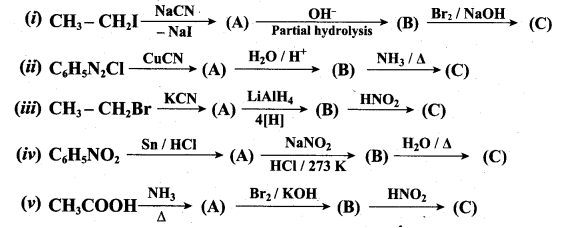
Complete the following reactions and identify the A, B and C in these reaction.
Image
An organic compound $( A )$ of molecular formula $CH _6$ reacts with $Br _2$ in the presence of $FeCl _3$ gives $( B )$ of formula $C _6 HBr$. B on treatment with mg in the presence of dry ether gives $( C )$ compound $( C )$ on treatment with dry ice followed by hydrolysis gives a compound (D) of molecular formula $C _7 H _6 O _2$. Identify $A, B, C, D$ and explain the reactions involved.
An organic compound $(A)$ of molecular formula $C _2 H _3 OCl$ on reaction with pd and $BaSO _4$ gives (B) of formula $C _2 H _4 O$. (B) on reaction with $LiAlH _4$ gives (C) of formula $C _2 H _6 O$. (B) on reaction with 12 and NaOH gives ( D ) of formula $CH _2 ONa$ and iodoform. identify $A , B , CD$ and explain the reactions involved.
Explain the effect of temperature on reaction rate based on Arrhenius theory.
Explain about the construction and uses of mercury button cell.