Question
What is apomixis and what is its importance?

Answer

Seeds, in general, are the product of fertilization but in some plants e.g. members of family Astraceae and grasses, seeds are produced without fertilization called apomixis. Thus, apomixis is a form of asexual reproduction. There are several ways of development of apomictic seeds. In some species, the diploid egg cell is formed without reduction division and develops into the embryo without fertilization. In citrus and mango varities some of nucellar cells start dividing, protrude into embryo sac and develop into embryos. In such species each ovule contains more than one embryos, referred as polyembryony.
Apomicts have several advantages particularly in hybrid seed industry. The hybrid varities are vigour, more productive and disease resistant but the production of hybrid seeds is very costly time consuming and do not maintain hybrid vigour in progeny due to segregation of characters/genes during the meiosis. If these hybrids are made into apomicts, there is no segregation of characters in the hybrid progeny and farmers can keep on using the hybrid seeds to raise new crops year after year and they do not have to buy hybrid seeds every year.
Need a full question paper?

Generate a complete, print-ready paper with questions like this in minutes — across 16+ boards, with answer keys.

Start Generating Free

Similar questions

  1. Draw the embryo sac of a flowering plant and label:
  1. Central cell
  2. Chalazal end of the embryo sac
  3. Synergids.
  1. Name the cell that develops into the embryo sac and explain how this cell leads to the formation of embryo sac. Also mention the role played by the various cells of the embryo sac.
Pragyan takes fruits, vegetables, bread and egg curry in a day's menu. While his teacher was giving a lecture on trophic level, he got fascinated and asked following questions from his teacher.
  1. How many trophic levels does he occupy in different food chains?
  2. Represent atleast three food chains.
  3. Which among them gives him the maximum amount of energy? Give reason.
  4. What values are shown by Pragyan?
Answer the following questions:
Explain the events that occur in a graafian follicle at the time of ovulation and thereafter.
In a biology class, teacher was telling the students that the structures/components and their functions in a watch can be compared with various levels of organisation we find in nature. Radhika was surprised and asked teacher to explain it. Teacher got impressed with Radhika's interest and explained that there is a systematic arrangement of smaller and simpler components into larger one in a hierarchy or pyramid having different levels where each level is formed of components of lower level and itself becomes part of higher level for achieving a common goal.
(i) What are the four levels of biological organisation found in nature?
(ii) What is the basic unit of ecological organisation?
(iii) Define community.
(iv) What values are shown by Radhika?
A particular garden pea plant produces only violet flowers.
  1. Is it homozygous dominant for the trait or heterozygous?
  2. How would you ensure its genotype? Explain with the help of crosses.
Compare the characteristic features of insect pollinated and wind pollinated flowers. Explain how the respective features assist in pollination.
Describe the post-zygotic events leading to implantation and placenta formation in humans. Mention any two functions of placenta.

OR

  1. Briefly explain the events of fertilisation and implantation in an adult human female.
  2. Comment on the role of placenta as an endocrine gland.
Highlights the reproductive health issues and strategies.
Explain the principle of insertional inactivation by giving a suitable example.
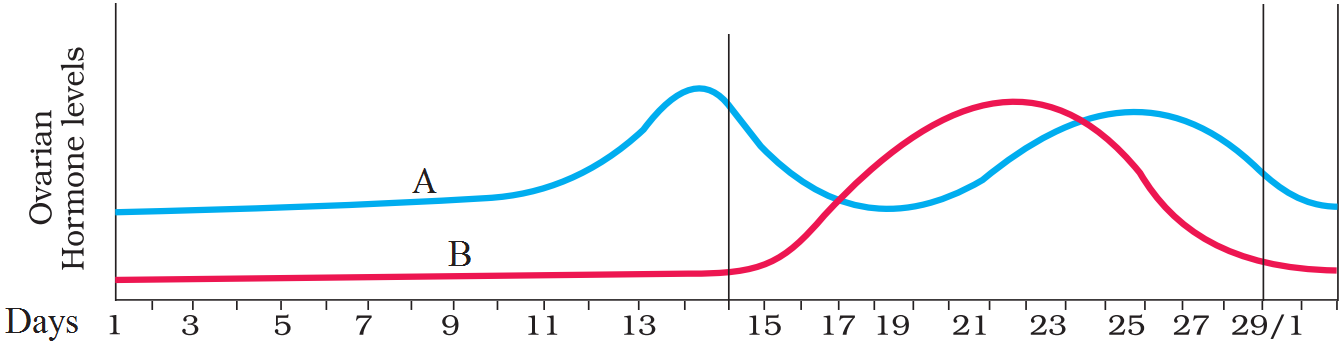
The graph given below shows the variation in the levels of ovarian hormones during various phases of menstrual cycle:

Compare the role of A and B.