Question
What is artificial insemination? Give its uses.

Answer

Artificial insemination (AI) is the process of collecting sperm cells from a male animal and manually depositing them into the reproductive tract of a female. Artificial insemination is commonly used instead of natural mating in many species of animals because of the many benefits it helps in.
  1. The ability to use sires of superior genetic merit (the best bulls of the breed).
  2. Improving production traits in cattle operation.
  3. The ability to mate specific sire to individual cows.
  4. Reducing the number of herd bulls needed in cattle operation.
  5. Increased genetics for replacement heifers.
  6. When combined with estrous synchronization, a shorter calving season can be achieved, resulting in a more consistent, uniform calf crop.

Need a full question paper?

Generate a complete, print-ready paper with questions like this in minutes — across 16+ boards, with answer keys.

Start Generating Free

Similar questions

Which has more atoms, 50g of aluminium or 50g of iron? Illustrate your answer with the help of calculations.
(Atomic masses: Al = 27u; Fe = 56u)

A ball X of mass 1kg travelling at 2m/s has a head-on collision with an identical ball Y at rest. X stops and Y moves off. Calculate the velocity of Y after the collision.
Mention any two desirable agronomic characters for crop improvement. Explain how farmers get desired characters incorporated into the new varieties produced. List two conditions necessary for the new varieties to be accepted.
If a planet existed whose mass was twice that of the earth and whose radius is 3 times greater. How much will a 1kg mass weigh in the planet?
What is kidnapped, blindfolded and imprisoned in a big room. How could the man tell if he was in: (a) a city (b) a village (c) a bare room (d) a furnished room.
Discuss the method of separating a mixture containing chalk powder, iron fillings and naphthalene.
A train travels the first 15km at a uniform speed of 30 km/h; the next 75km at a uniform speed of 50km/h; and the last 10km at a uniform speed of 20km/h.
Calculate the average speed for the entire train journey.
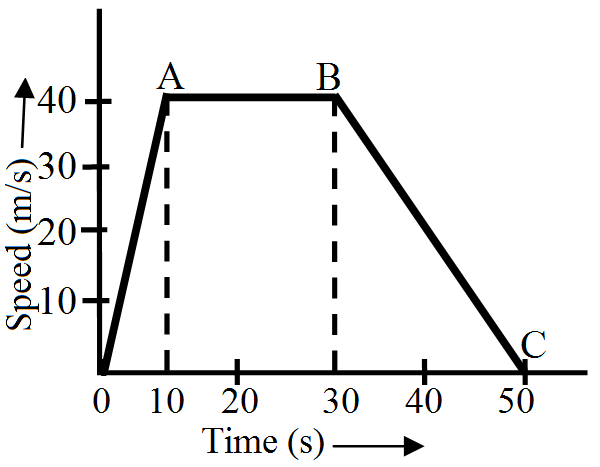
Study the speed-time graph of a car given alongside and answer the following questions:

  1. What type of motion is represented by OA?
  2. What type of motion is represented by AB?
  3. What type of motion is represented by BC?
  4. What is the acceleration of car from O to A?
  5. What is the acceleration of car from A to B?
  6. What is the retardation of car from B to C?

Describe the various levels of causes of disease.

Describe structure and functions of Golgi apparatus.