Question
What is being done to change the range of voltmeter?

Answer

$R _{ H }=\left(\frac{ V }{i_g}\right)- G$.
On joining this high resistance to the given galvanometer in series, it will become voltmeter of range V . When high resistance $R _{ H }$ is joined with galvanometer in series, the effective resistance $R _{ V }=\left( R _{ H }+ G \right)$ of galvanometer becomes very high (camparison to G). So, when such a voltmeter is connected in parallel in a circuit to measure potential difference, then due to its high resistance, it allows very small fraction of total current to pass through it and hence gives reading of potential difference corresponding to total current flowing through the circuit.

Need a full question paper?

Generate a complete, print-ready paper with questions like this in minutes — across 16+ boards, with answer keys.
Start Generating Free

Similar questions

An atom absorbs a photon of wavelength 500nm and emits another photon of wavelength 700nm. Find the net energy absorbed by the atom in the process.
A farsighted person cannot see objects placed closer to 50cm. Find the power of the lens needed to see the objects at 20cm.
A hydrogen atom contains one proton and one electron. It may be assumed that the electron revolves in a circle of radius 0.53 angstrom (1 angstrom = 10-10m and is abbreviated as A) with the proton at the centre. The hydrogen atom is said to be in the ground state in this case. Find the magnitude of the electric force between the proton and the electron of a hydrogen atom in its ground state.
From what it can be said that the electric charge on any object is always an integral multiple of 'e' ?
The frequency ν of incident radiation is greater than threshold frequency (ν0) in a photocell. How will the stopping potential vary if frequency (ν) is increased, keeping other factors constant?
In half-wave rectification, what is the output frequency if the input frequency is 50 Hz. What is the output frequency of a full-wave rectifier for the same input frequency?
Write the difference between $p$-type and n-type semiconductors.
The rest mass of the photon is zero. Explain it.
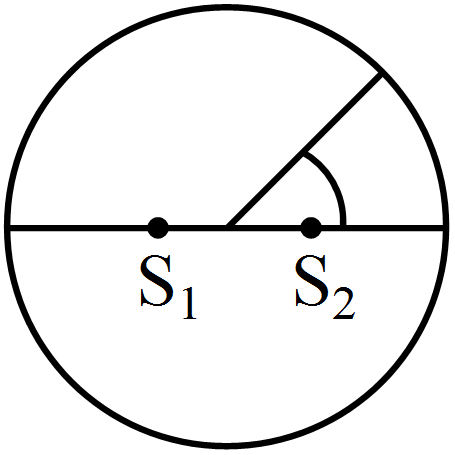
Figure, shows two coherent sources S1 and S2 which emit sound of wavelength $\lambda$ in phase. The separation between the sources is $3\lambda.$ A circular wire of large radius is placed in such a way that S1S2 lies in its plane and the middle point of S1S2 is at the centre of the wire. Find the angular positions $\theta$ on the wire for which constructive interference takes place.

What are diamagnetic substances? Give one example.