Question
What is called degree of freedom? How many types are there? Explain to them.

Answer

SELF

Need a full question paper?

Generate a complete, print-ready paper with questions like this in minutes — across 16+ boards, with answer keys.
Start Generating Free

Similar questions

Three identical charges, each having a value $1.0 \times 10^{-8}C$, are placed at the corners of an equilateral triangle of side $20cm$. Find the electric field and potential at the centre of the triangle.
A stream of water flowing horizontally with a speed of $15ms^{-1}$ gushes out of a tube of cross-sectional area $10^{-2}m^2$, and hits a vertical wall nearby. What is the force exerted on the wall by the impact of water, assuming it does not rebound?
In beta decay, an electron (or a positron) is emitted by a nucleus. Does the remaining atom get oppositely charged?
A mild steel wire of length $1.0m$ and cross-sectional area $0.50 \times 10^{-2}cm^2$ is stretched, well within its elastic limit, horizontally between two pillars. A mass of $100g$ is suspended from the mid-point of the wire. Calculate the depression at the midpoint.
The blades of a windmill sweep out a circle of area A.
  1. If the wind flows at a velocity v perpendicular to the circle, what is the mass of the air passing through it in time t?
  2. What is the kinetic energy of the air?
  3. Assume that the windmill converts 25% of the wind's energy into electrical energy, and that $A = 30m^2, v = 36km/ h$ and the density of the air is $1.2kg/ m^{-3}$. What is the electrical power produced?
A particle of mass $1kg$ moving with a velocity $\text{V}_1=(3\hat{\text{i}}-2\hat{\text{J})}\text{m/ s}$ experience a perfectly inelastic collision with another particle of mass 2kg having velocity $\text{v}_2=4\hat{\text{j}}-6\hat{\text{k}}\text{m/ s}$. Find the velocity and speed of the particle formed.

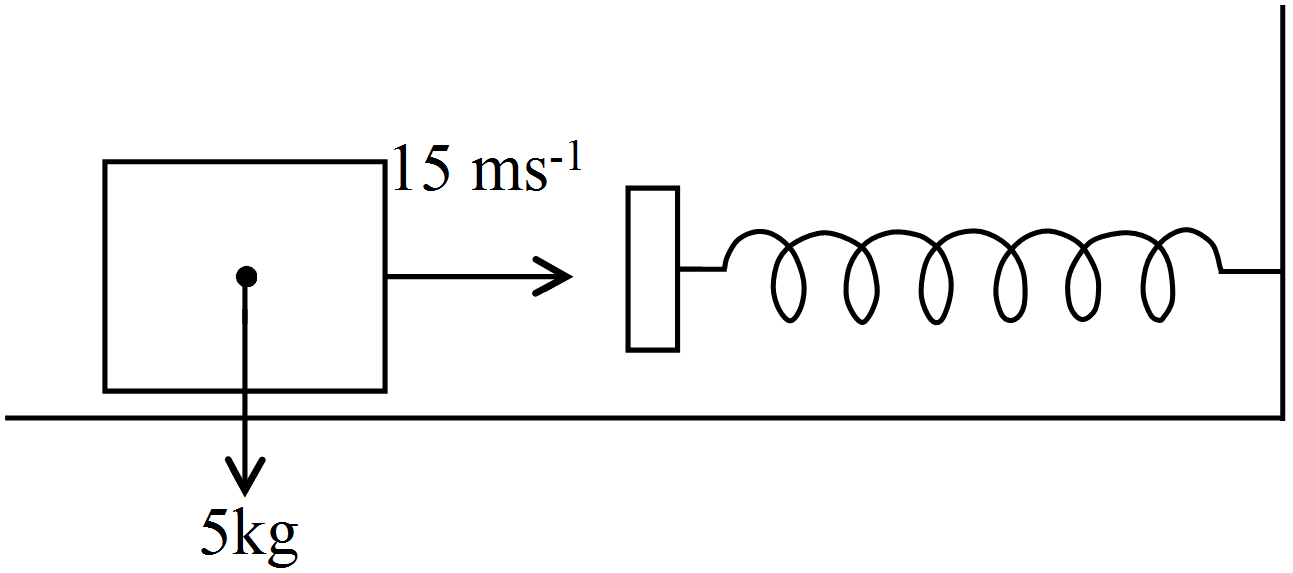
If the spring constant of the spring is 250N/ m, find the maximum compression of the spring.
A 50-turn circular coil of radius 2.0cm carrying a current of 5.0A is rotated in a magnetic field of strength 0.20T.
  1. What is the maximum torque that acts on the coil?
  2. In a particular position of the coil, the torque acting on it is half of this maximum. What is the angle between the magnetic field and the plane of the coil?
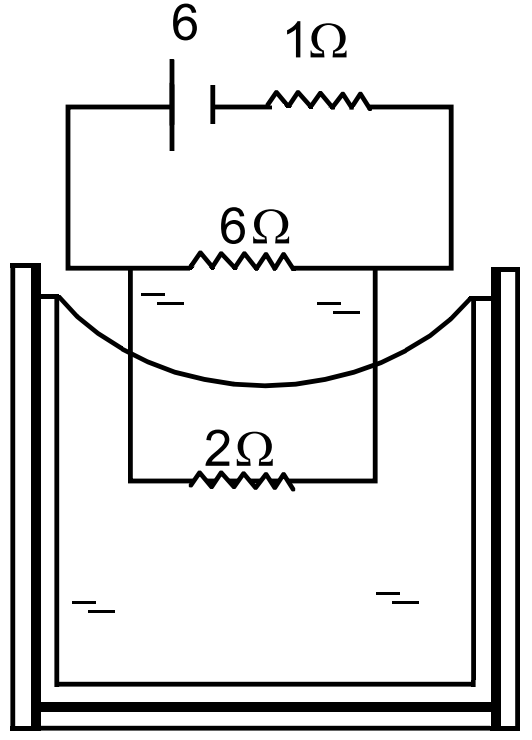
The $2.0Ω$ resistor shown in the figure is dipped into a calorimeter containing water. The heat capacity of the calorimeter together with water is $2000JK-^1$.
  1. If the circuit is active for $15$ minutes, what would be the rise in the temperature of the water?
  2. Suppose the $6.0Ω$ resistor gets burnt. What would be the rise in the temperature of the water in the next $15$ minutes?
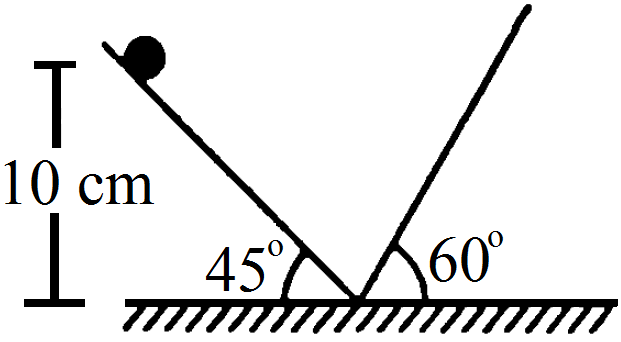
Find the time period of the motion of the particle shown in figure Neglect the small effect of the bend near the bottom.