Question
What is called depletion region?

Answer

The region free from (devoid of) charge carriers located near the P-N junction is called depletion region.

Need a full question paper?

Generate a complete, print-ready paper with questions like this in minutes — across 16+ boards, with answer keys.
Start Generating Free

Similar questions

Define the term ‘dielectric constant’ of a medium in terms of capacitance of a capacitor.
In an n-type silicon, which of the following statement is true:
  1. Electrons are majority carriers and trivalent atoms are the dopants.
  2. Electrons are minority carriers and pentavalent atoms are the dopants.
  3. Holes are minority carriers and pentavalent atoms are the dopants.
  4. Holes are majority carriers and trivalent atoms are the dopants.
In a transistor:
  1. The emitter has the least concentration of impurity.
  2. The collector has the least concentration of impurity.
  3. The base has the least concentration of impurity.
  4. All the three regions have equal concentrations of impurity.
How many types of wavefronts are there? Write.
Can internal resistance of car batteries be determined with the help of Wheatstone bridge?
What is the value of electrical conductivity of a semiconductor at absolute zero?
Can a charged particle be accelerated by a magnetic field? Can its speed be increased?
A sphere of radius 1.00cm is placed in the path of a parallel beam of light of large aperture. The intensity of the light is $0.5W/cm^{-2}$. If the sphere completely absorbs the radiation falling on it, find the force exerted by the light beam on the sphere.
For the telescope described in, what is the separation between the objective lens and the eyepiece?
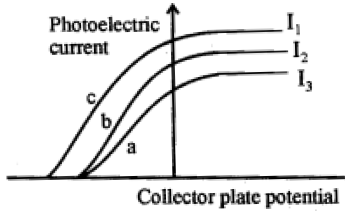
The figure shows a plot of three curves a, b, c showing the variation of photocurrent vs collector plate potential for three different intensities $\mathrm{I}_1, \mathrm{I}_2$ and $\mathrm{I}_3$ having frequencies $\sqrt{1}, \sqrt{2}$ and $\sqrt{3}$, respectively incident on a photosensitive surface.
Point out the two curves for which the incident radiations have same frequency but different intensities.