Question
What is called stream line flow?

Answer

When the flow of a fluid is such that the direction of every particle of the fluid passing through a point is the same as that of first particle that passed through that point, then the flow of the fluid is on streamline represents the direction of velocity of the liquid at that point.

Need a full question paper?

Generate a complete, print-ready paper with questions like this in minutes — across 16+ boards, with answer keys.
Start Generating Free

Similar questions

Find the value of $x$ in the following relation.
$(\text { Velocity })^x=\binom{\text { Pressure }}{\text { difference }}^{3 / 2} \times(\text { Density })^{-3 / 2}$
The gravitational field in a region is given by $\overrightarrow{\text{E}}=(5\text{N/kg})\overrightarrow{\text{i}}+(12\text{N/kg})\overrightarrow{\text{j}}.$
  1. Find the magnitude of the gravitational force acting on a particle of mass 2kg placed at the origin.
  2. Find the potential at the points (12m, 0) and (0, 5m) if the potential at the origin is taken to be zero.
  3. Find the change in gravitational potential energy if a particle of mass 2kg is taken from the origin to the point (12m, 5m).
  4. Find the change in potential energy if the particle is taken from (12m, 0) to (0, 5m).
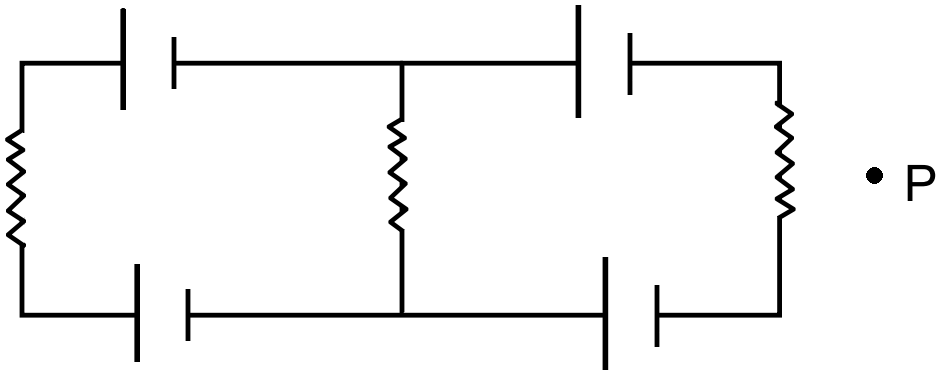
Each of the batteries shown in figure has an emf equal to 5V. Show that the magnetic field B at the point P is zero for any set of values of the resistances.

A diatomic gas is suddenly compressed to 1/4 of its initial volume. Find the ratio of final and initial pressure $(\gamma = 1.5)$.
Under what circumstances would your weight become zero?
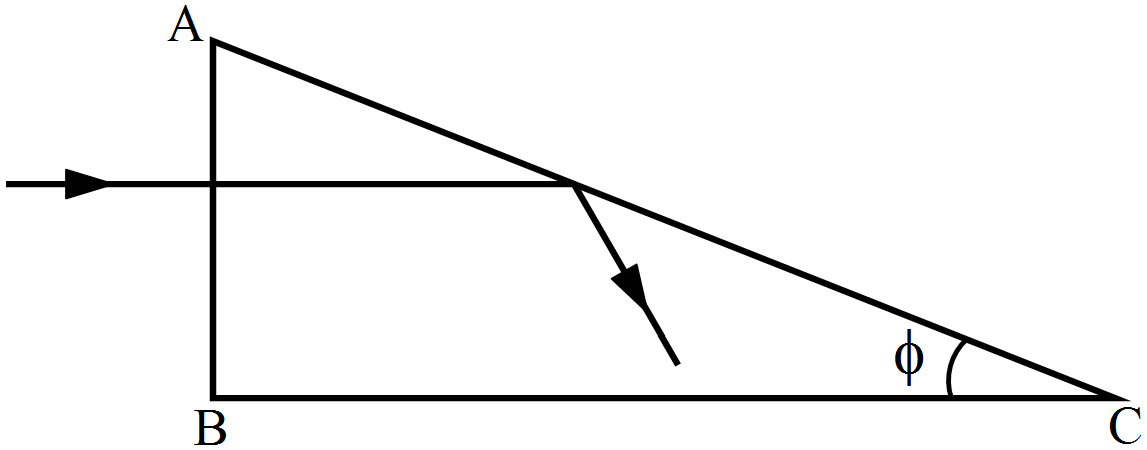
 A light ray is incident normally on the face AB of a right-angled prism ABC $(\mu=1.50)$ as shown in figure. What is the largest angle $\phi$ for which the light ray is totally reflected at the surface AC? 

A rocket is fired with a velocity 0.6 times the escape velocity on the surface of earth. How high will it go from the surface?
At what speed the volume of an object shrinks to half its rest value?
A cubical block of steel of density 7.8g cm-3 floats on mercury (density 13.6g cm-3) with its sides vertical. Assume the side of the cube to be 10cm.
  1. What length of the block is above the mercury surface?
  2. If water is poured on the mercury surface, what will be the height of the water column, when the water surface just covers the top of the steel block?
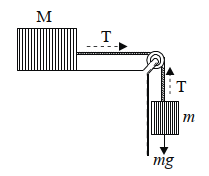
According to the figure, if the coefficient of static friction between block of mass 2 kg and the table is $\mu_s=0.2$ then what should be the maximum value of $m$ so that the block does not move while the pulley is light and frictionless.
Image