Question
What is carbyl amine reaction?

Answer

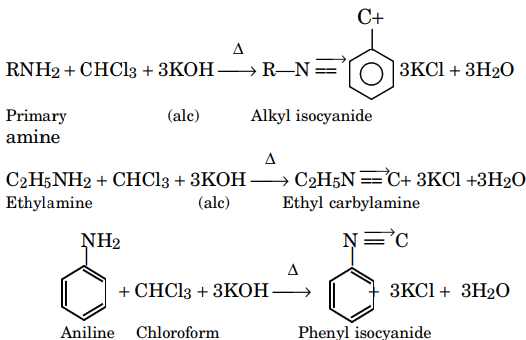
Carbylamine reaction or isocyanide test : Aliphatic and aromatic primary amines when heated with chloroform and alcoholic KOH solution produce isocyanides or carbylamines which are foul smelling substances. Secondary and tertiary amines do not undergo this reaction.
Image

Need a full question paper?

Generate a complete, print-ready paper with questions like this in minutes — across 16+ boards, with answer keys.

Start Generating Free

Similar questions

Out of pure liquid and azeotrope showing positive deviation, Which one has a higher boiling point?
Read the following text carefully and answer the questions that follow:
The f-block consists of elements in which 4f and 5f orbitals are progressively filled. They are placed in a separate panel at the bottom of the periodic table. The names transition metals and inner transition metals are often used to refer to the elements of d-and f-blocks respectively. The d-block occupies the large middle section of the periodic table flanked between s and p blocks in the periodic table. In general, the electronic configuration of the outer orbitals of these elements is (n-1)d1-10ns1-2. The electronic configurations of outer orbitals of Zn, Cd, Hg and Cn are represented by the general formula (n - 1)d10ns2. The transition metals and their compounds also exhibit catalytic property and paramagnetic behaviour. Transition metal also forms an alloy. An alloy is a blend of metals prepared by mixing the components. Alloys may be homogeneous solid solutions in which the atoms of one metal are distributed randomly among the atoms of the other.
i. Transition metals form alloys. Justify? 
ii. Why do transition elements exhibit higher enthalpies of atomization? 
iii. Transition metals and many of their compounds show paramagnetic behaviour. Give reason.
A solution of glucose in water is labelled as 10% w/w, what would be the molality and mole fraction of each component in the solution? If the density of solution is 1.2 g mL-1, then what shall be the molarity of the solution?
How is 1-propoxypropane synthesised from propan-1-ol? Write mechanism of this reaction.
What is the effect of pressure and temperature on crystal structure?
Explain with equations, the nucleophilic addition reaction of aldehydes and ketones with Grignard's reagent (R'-Mg-X).
Discuss the nature of bonding in [Co(NH3)6]3+ coordination entities on the basis of valence
bond theory
Give equations for the following reactions :
(i) Oxidation of propan-1-ol with alkaline $KMnO _4$ solution.
(ii) Bromine in presence of $C S _{ 2 }$ with phenol.
(iii) Dilute nitric acid with phenol.
The mole fraction of helium in a saturated solution at 20°C is 1.2 g 10-6. Find the pressure of helium above the solution. Given Henry's constant at 20°C is 144.97 kbar. (2)
Read the following text carefully and answer the questions that follow:
The actinoids include the fourteen elements from Th to Lr. The actinoids are radioactive elements and the earlier members have relatively long half-lives, the latter ones have half-life values ranging from a day to 3 minutes for lawrencium. The latter members could be prepared only in nanogram quantities. Actinoids show a greater range of oxidation states. The elements, in the first half of the series frequently exhibit higher oxidation states. The actinoids resemble the lanthanoids in having more compounds in +3 state than in the +4 state. All the actinoids are believed to have the electronic configuration of 7s2 and variable occupancy of the 5f and 6d subshells. The magnetic properties of the actinoids are more complex than those of the lanthanoids. The variation in the magnetic susceptibility of the actinoids with the number of unpaired 5f electrons is roughly parallel to the corresponding results for the lanthanoid.
i. Actinoid contraction is greater from element to element than lanthanoid contraction. Why?
ii. Actinoids show irregularities in their electronic configuration. Justify?
iii. The actinoid metals are all silvery in appearance but display a variety of structures than lanthanoid give reason.
OR
iii. The magnetic properties of the actinoids are more complex than those of the lanthanoids. Why?