Question
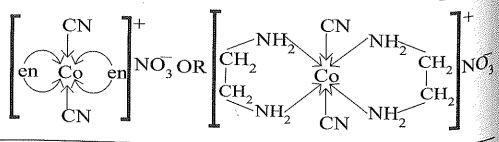
What is Chelate ligand? Explain Chelate Complex.

Answer

→ When multidentate ligands like en, OX2-, pn, ptn, (EDTA)4- form coordinate covalent bond with metal ion, it results into cyclic structure involving central metal ion. Thus, the complex compound formed by ligand and metal ion having cyclic structure is called chelate complex and the ligand is known as chelate ligand.
→ The stability of such chelate compounds is more than the stability of simple complex compounds
Image

Need a full question paper?

Generate a complete, print-ready paper with questions like this in minutes — across 16+ boards, with answer keys.
Start Generating Free

Similar questions

State Raoult’s law for solutions of volatile liquid components. Taking a suitable example, explain the meaning of positive deviation from Raoult’s law.
Nitrogen pentoxide decomposes according to equation: $\text{2N}_{2}\text{O}_{5}\text{(g)}\rightarrow\text{4NO}_{2}\text{(g)}+\text{O}_{2}\text{(g)}.$
This first order reactionwas allowed to proceed at 40° C and the data below were collected:
[N2O5](M) Time (min)
0.400 0.00
0.289 20.0
0.209 40.0
0.151 60.0
0.109 80.0
  1. Calculate the rate constant. Include units with your answer.
  2. What will be the concentration of N2O5 after 100 minutes?
  3. Calculate the initial rate of reaction.
Which of the following compounds (a) and (b) will not react with a mixture of NaBr and H2SO4. Explain why?

  1. $\text{CH}_3\text{CH}_2\text{CH}_2\text{OH}$
  2.  

$^{238}_{92}\text{U}$ Change to $^{206}_{92}\text{Pb}$ by successive radioactive decay. A sample of urenium ore was anlaysed and found to contain 1.0 g of $^{238}\text{U}$ and 0.1 g of $^{206}\text{Pb}$ had accumulated due to decay of $^{238}\text{U}$, find out the age of ore. (Half- life of $^{238}\text{U}$$= 4.5\times10^9$ years).
What are nucleic acids? Mention their two important functions.
Propose the mechanism for the following reaction:
$\text{CH}_3\text{CHO}\ \ +\ \ \text{HCN}\xrightarrow{\ \ \text{a}+ }\ \ \text{CH}_3-\text{CH}-\text{CN}\\ \ \ \ \ \ \ \ \ \ \ \ \ \ \ \ \ \ \ \ \ \ \ \ \ \ \ \ \ \ \ \ \ \ \ \ \ \ \ \ \ \ \ \ \ \ \ \ \ \ \ \ \ \ \ \ \ \ \ | \\ \ \ \ \ \ \ \ \ \ \ \ \ \ \ \ \ \ \ \ \ \ \ \ \ \ \ \ \ \ \ \ \ \ \ \ \ \ \ \ \ \ \ \ \ \ \ \ \ \ \ \ \ \ \ \ \ \ \ \text{OH}$
Draw optical isomers of cis $\left[ PtCl _2( en )_2\right]$.
How will you carry out the following conversions?
  1. toluene → p-toluidine.
  2. p-toluidine diazonium chloride → p-toluic acid.
Write the mechanism of acid dehydration of ethanol to yield ethene.
How would you account for the irregular variation of ionisation enthalpies (first and second) in the first series of the transition elements?