Question
What is chromatography? State its two applications.

Answer

Chromatography is a technique of separating two or more dissolved solids which are present in a solution in very small quantities. Its two applications are:
  1. Chromatography is used to separate solutions of coloured substances (dyes and pigments).
  2. Chromatography is used to separate small amounts of products of chemical reactions.

Need a full question paper?

Generate a complete, print-ready paper with questions like this in minutes — across 16+ boards, with answer keys.
Start Generating Free

Similar questions

How will you separate water from mustard oil?
An atom X has 4 protons and 5 neutrons with electronic configuration 2, 2. Give information about its.
  1. Atomic number.
  2. Mass number.
  3. Valency.
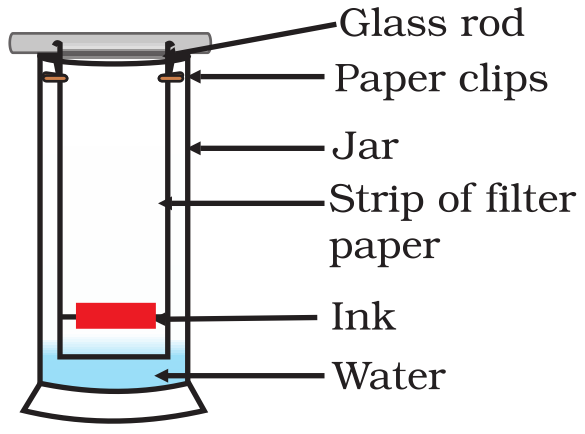
A child wanted to separate the mixture of dyes constituting a sample of ink. He marked a line by the ink on the filter paper and placed the filter paper in a glass containing water as shown in the filter paper was removed when the water moved near the top of the filter paper.


  1. What would you expect to see, if the ink contains three different coloured components?
  2. Name the technique used by the child.
  3. Suggest one more application of this technique.
Calculate the molecular masses of the following compounds:
  1. Methane, CH4
  2. Ethane, C2 H6
  3. Ethene, C2 H4
  4. Ethyne, C2 H2
(Atomic masses: C = 12u; H = 1u)
Why does the temperature remain constant during the melting of ice even though heat is supplied continuously?
List the points of differences between homogeneous and heterogeneous mixtures.
Write the steps you would use for making tea. Use the words solution, solvent, solute, dissolve, soluble, insoluble, filtrate and residue.
Calculate the molecular masses of the following:
  1. Hydrogen, H2
  2. Oxygen, O2
  3. Chlorine, Cl2
  4. Ammonia, NH3
  5. Carbon dioxide, CO2
(Atomic masses: H = 1 u; O = 16 u; Cl = 35.5 u; N = 14 u; C = 12 u)
You are provided with soda water, milk and muddy water. How can you differentiate between them in terms of:
  1. Homogeneity.
  2. Filtration.
  3. Tyndall effect.
To make a saturated solution, 36g of sodium chloride is dissolved in 100g of water at 293K. Find its concentration at this temperature.