Question
What is concurrent force? What is the necessary condition for the balance of concurrent forces?
Answer

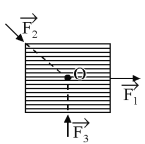
 Concurrent forces : If the lines of action of forces acting on an object pass through a common point then it is called concurrent forces.
In the figure, the lines of action of $\vec{F}_1, \vec{F}_2$ and $\vec{F}_3$ are passing forces $F _1, F_2$ and $F _3$ are passing
through a common point $O$. Hence $\vec{F}_1$, $\rightarrow \quad \rightarrow$ $F_2$ and $F_3$ are concurrent forces. When concurrent forces are applied on a body only linear acceleration can occur in that body.
Image

Equilibrium of concurrent forces : When many forces are acting on an object yet there is no change in state of object then the object is said to be in equilibrium. In this situation, the vector sum of forces should be zero. Hence if vector sum of accompanying forces is zero then it is called the equilibrium state of forces.That is, concurrent forces $\overrightarrow{ F }_1, \overrightarrow{F_2} \ldots \ldots . \overrightarrow{ F }_n$ will be in equilibrium if,
$
\overrightarrow{F_1}+\overrightarrow{F_2}+\overrightarrow{F_3}+\overrightarrow{F_4}+\overrightarrow{F_5}+\ldots \ldots . \overrightarrow{F_n}=0$
On writing as components,
$\begin{array}{l}
\overrightarrow{F}_{1 x}+\overrightarrow{F}_{2 x}+\overrightarrow{F}_{3 x}+\ldots \ldots \cdot \overrightarrow{F}_{n x}=0 \\
\overrightarrow{F}_1 y+\overrightarrow{F}_{2 y}+\overrightarrow{F}_{3 y}+\ldots \ldots \cdot \overrightarrow{F}_{n y}=0 \\
\overrightarrow{F}_{1 z}+\overrightarrow{F}_{2 z}+\overrightarrow{F}_{3 z}+\ldots \ldots \cdot \overrightarrow{F}_{n z}=0
\end{array}$
Therefore, for concurrent forces to balance, the sum of component of forces along any axis (direction) must be zero.

Need a full question paper?

Generate a complete, print-ready paper with questions like this in minutes — across 16+ boards, with answer keys.

Start Generating Free

Similar questions

A policeman on duty detects a drop of 15% in the pitch of the horn of a motor car as it crosses him. If the velocity of sound is 330m/sec, calculate the speed of the car.
Two neutral particles are kept 1m apart. Suppose by some mechanism some charge is transferred from one particle to the other and the electric potential energy lost is completely converted into a photon. Calculate the longest and the next smaller wavelength of the photon possible.
A raindrop of mass $1.00g$ falling from a height of $1km$ hits the ground with a speed of $50m s^{-1}$. Calculate:
  1. The loss of $P.E.$ of the drop.
  2. The gain in $K.E$. of the drop.
  3. Is the gain in $K.E$. equal to loss of $P.E$.? If not why.
Take $g = 10m s^{-2}$
A car start from rest and accelerates to attains a velocity of $30 m / s$ in 12 sec . Then find (i) acceleration of that car, (ii) total distance covered, (iii) velocity after 7 sec
Water falling from a $50m$ high fall is to be used for generating electric energy. If $1.8 x 10^5kg$ of water falls per hour and half the gravitational potential energy can be converted into electric energy, how many $100W$ lamps can be lit?
Express unified atomic mass unit in kg.
Briefly discuss subtraction of vectors.
The force of surface tension acts tangentially to the surface whereas the force due to air pressure acts perpendicularly on the surface. How is then the force due to excess pressure inside a bubble balanced by the force due to the surface tension?
Considering the pressure p to be proportional to the density, find the pressure p at a height h if the pressure on the surface of the earth is $p_0$.
Show that $\text{AB} + \overline{\text{AB}}$ is always 1.