- Debentures are one of the main sources of raising debt capital for meeting long-term and medium-term financial needs.
- Debentures represent borrowed capital.
- A person who purchased debenture is called a debenture holder.
- The holders get a fixed rate of interest as a return on their investment.
- The Board of Directors has the power to issue debentures.
Definitions:
Topham defines: “A debenture is a document given by a company as evidence of debt to the holder, usually arising out of the loan and most commonly secured by the charge.”
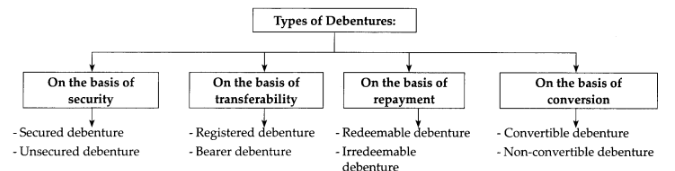
They are as follows:
(i) Secured Debentures:
- The debentures can be secured.
- The property of a company is charged as security for the loan.
- The security may be for some particular asset (fixed charge) or it may be the asset in general (floating charge).
- The debentures are secured through ‘Trust Deed’.
(ii) Unsecured Debentures:
- These debentures do not have security.
- The issue of unsecured debentures is prohibited by the Companies Act, 2013.
(iii) Registered Debentures:
- They are the ones whose details are mentioned in the Register of debenture maintained by the company.
- The details include the name, address, particulars of
- The transfer of such debentures requires the execution of regular transfer deeds.
- Interest is paid through Dividend warrants.
(iv) Bearer Debentures:
- The details of the debentures are not recorded in the register of the debenture.
- Their names do not appear in the Register of Debenture Holders.
- Such debentures are transferred by mere delivery.
- Payment of interest is made by means of coupons attached to the debentures certificate.
(v) Redeemable Debentures:
- Debentures are mostly redeemable i.e. payable at the end of some fixed period, mentioned on the Debentures Certificate.
- Repayment may be made at a fixed date, at the end of a specific period, or six installments during the lifetime of the company.
- The provision of repayment is normally made in Trust Deed.
(vi) Irredeemable Debentures:
- These debentures are not repayable during the lifetime of the company.
- They are repayable only on liquidation of the company or when there is a breach of any condition or in contingencies.
(vii) Convertible Debentures:
- These debentures give the right to the holder to convert the debentures into equity shares after a specific period.
the period of conversion is mentioned in the debenture certificate. - The issue must be approved by a special resolution in the general meeting before they are issued to the public.
- A Convertible debentures holder is hence entitled to equity shares at a rate lower than the market value after which he can participate in the profits and meetings of the company.
(viii) Non-Convertible Debentures:
- These are not convertible into equity shares on maturity.
- They are normally redeemed on the maturity date.
- There is no appreciation in their value which acts as a disadvantage.