Question
What is doping ? - Explain.

Answer

"The deliberate addition of a desired impurity is called doping. And the impurity atoms are called dopants. Such a material is also called a doped semiconductor (or extrinsic semiconductors or impurity semiconductors.)".
The dopant atom (impurity atom) has to be such that it does not distort the original pure semiconductor lattice.
It occupies only a very few of the original semiconductor sites in the crystal. A necessary condition to attain this is that the sizes of the dopant and the semiconductor atoms should be nearly same.
Generally a small amount, say, a few parts per million (ppm), of a suitable impurity is added to the pure semi-conductor. Due to the added impurity atoms, the conductivity of the semiconductor is increased manifold.
There are two types of dopants used in doping the tetravalent $S i$ or Ge:
(i) Pentavalent (Valency 5) : like Arsenic (As), Antimony (S $b$ ), Phosphorous ( P ), etc.
(ii) Trivalent (Valency 3) : like Indium (I $n$ ) Boron (B), Aluminium $( A l$ ) etc.

Need a full question paper?

Generate a complete, print-ready paper with questions like this in minutes — across 16+ boards, with answer keys.
Start Generating Free

Similar questions

de Broglie wavelength associated with an electron accelerated through a potential difference V is $\lambda$ What will be the de Broglie wavelength when the accelerating potential is increased to 4V?
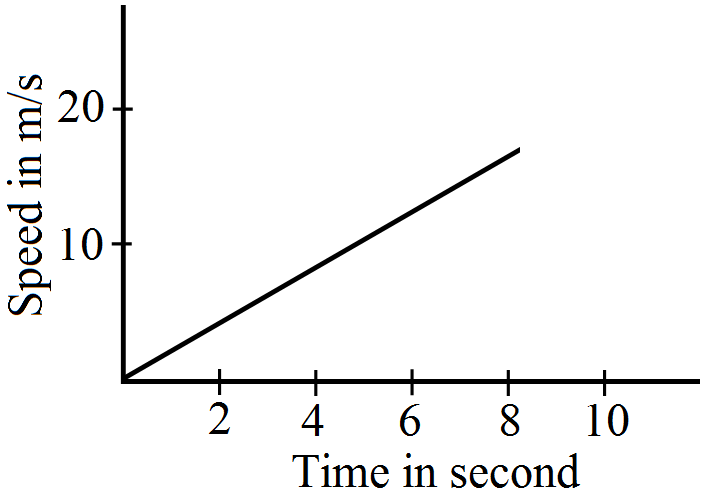
The speed of a car as a function of time is shown in figure. Find the distance travelled by the car in 8 seconds and its acceleration.

The 200m free style women's swimming gold medal at Seol Olympic 1988 went to Heike Friendrich of East Germany when she set a new Olympic record of 1 minute and 57.56 seconds. Assume that she covered most of the distance with a uniform speed and had to exert 460W to maintain her speed. Calculate the average force of resistance offered by the water during the swim.
Give the characteristics of magnetic field lines.
Can fringes of white light be formed in interference or not? If yes, under what circumstances?
Explain current sensitivity and voltage sensitivity of galvanometer.
Estimate the distance for which ray optics is good approximation for an aperture of 4 mm and wavelength 400 nm.
Provide the comparison (analogy) between Electro Statics and Magnetism.
What is electron emission ? Explain its types.