Question
What is ‘effective demand’? How will you derive the autonomous expenditure multiplier when price of final goods and the rate of interest are given?
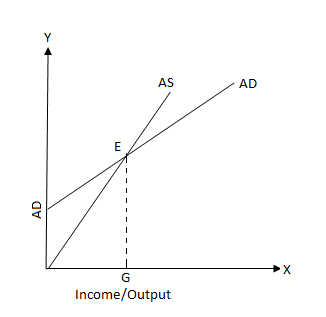 The x-axis represents income/ output level and y-axis represents the level of aggregate demand. E is the equilibrium point where the two curves AS and AD meet. EG is the effective demand and output level is determined by AD (assuming the elasticity of supply to be perfectly elastic). Autonomous expenditure multiplier is derived as: Y = AD (at equilibrium) Y = A + cY [Where AD = A + cY] Y - cY = A Y (1 - c) = A
 $\text{Y}=\frac{\text{A}}{1-\text{c}}$
Where, A = Autonomous expenditure c = MPC Y = level of income$\frac{1}{1-\text{c}}=$ autonomous expenditure multiplier.
So, the autonomous expenditure multiplier is dependent on the income and MPC.Generate a complete, print-ready paper with questions like this in minutes — across 16+ boards, with answer keys.
Calculate:
| | | (Rs. Crores) |
| (i) | Net current transfers to abroad | 15 |
| (ii) | Private final consumption expenditure | 800 |
| (iii) | Net imports | (-)20 |
| (iv) | Net domestic capital formation | 100 |
| (v) | Net factor income to abroad | 10 |
| (vi) | Depreciation | 50 |
| (vii) | Change in stocks | 17 |
| (viii) | Net indirect tax | 120 |
| (ix) | Government final consumption expenditure | 200 |
| (x) | Exports | 30 |