Question
What is electron emission ? Explain its types.

Answer

→"When electron in a metal possessing sufficient energy, the phenomenon of electrons leaving the metal is called electron emission."
• Types of Electron Emission :
The energy required to eject an electron from a metal can be given in different ways. There are three types of electron emission based on it.
(i) Thermionic emission :
Properly heating the metal gives thermal energy to the electrons in it. By absorbing this energy, electrons can escape from the metal.
(ii) Field emission :
Applying a very strong electric field (of the order of $10^8 Vm ^{-1}$ ) to the metal can pull electrons out of the metal.
(iii) Photo electric emission :
When light of sufficient frequency is incident on a metal surface, electrons are emitted from the metal. This phenomenon is called photoelectric effect and the emitted electrons are called photo-electrons.

Need a full question paper?

Generate a complete, print-ready paper with questions like this in minutes — across 16+ boards, with answer keys.
Start Generating Free

Similar questions

The separation between the consecutive dark fringes in a Young's double slit experiment is 1.0mm. The screen is placed at a distance of 2.5m from the slits and the separation between the slits is 1.0mm. Calculate the wavelength of light used for the experiment.
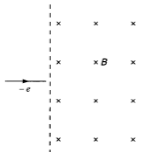
$a.$ An electron moving horizontally with a velocity of $4 \times 10^4\ m / s$ enters a region of uniform magnetic field of $10^{-5} T$ acting vertically upward as shown in the figure. Draw its trajectory and find out the time it takes to
Image

$b.$ A straight wire of mass $200 g$ and length $1.5 m$ carries a current of $2 A.$ It is suspended in mid air by a uniform magnetic field $B.$ What is the magnitude of the magnetic field?
A free neutron beta-decays to a proton with a half-life of 14 minutes.
  1. What is the decay constant?
  2. Find the energy liberated in the process.
The minimum deviations suffered by red, yellow and violet beams passing through an equilateral transparent prism are 38.4°, 38.7° and 39.2° respectively. Calculate the dispersive power of the medium.
A rectangular coil of 100 turns has length 5cm and width 4cm. It is placed with its plane parallel to a uniform magnetic field and a current of 2A is sent through the coil. Find the magnitude of the magnetic field B if the torque acting on the coil is $0.2N\  m^{-1}.$
Write the difference between $p$-type and n-type semiconductors.
How does the conductivity of semiconductors increase with increasing temperature?
The refractive index of the material of a convex lens is 1.5 and the radii of curvature of both its surfaces are equal. Prove that its focal length is equal to the radius of curvature.
Two bar magnets are placed close to each other with their opposite poles facing each other. In absence of other force the magnets are pulled towards each other and their kinetic energy increases. Does it contradict our earher knowledge that magnetic forces cannot do any work and hence cannot increase kinetic energy of a system?
With the help of suitable diagram explain the real depth and apparent depth.