Question
What is gene therapy? Illustrate using the example of adenosine deaminase (ADA) deficiency.

Answer

→ Gene therapy is a collection of methods that allows correction of a gene defect that has been diagnosed in a child/embryo.
→ Here by using DNA medicinal protein is produce which correct or treat the mutated Gene.
→ Here genes are inserted into a person's cells and tissues to treat a disease.
→ Correction of a genetic defect involves delivery of a normal gene in to the individual or embryo. to take over the function of and compensate for the non-functional gene.
→ Example- Adenosine deaminase deficiency
→ The first clinical gene therapy was given in 1990 to a 4-year old girl with adenosine deaminase (ADA) deficiency.
→ This enzyme is crucial for the immune system to function.
→ The disorder is caused due to the deletion of the gene for adenosine deaminase.
→ In some children ADA deficiency can be cured by bone marrow transplantation.
→ In others it can be treated by enzyme replacement therapy, in which functional ADA is given to the patient by injection.
→ But the problem with both of these approaches that they are not completely curative. As a first step towards gene therapy, lymphocytes from the blood of the patient are grown in a culture outside the body.
→ A functional ADA CDNA (using a retroviral vector) is then introduced into these lymphocytes, which are subsequently returned to the patient.
→ However, as these cells are not immortal, the patient requires periodic infusion of such genetically engineered lymphocytes.
→ However, if the gene isolate from marrow cells producing ADA is introduced into cells at early embryonic stages, it could be a permanent cure.
Need a full question paper?

Generate a complete, print-ready paper with questions like this in minutes — across 16+ boards, with answer keys.

Start Generating Free

Similar questions

Read the following and answer any four questions from (i) to (v) given below:
The foundations of recombinant DNA (rDNA) were laid by the discovery of restriction enzymes. These enzymes are present in many bacterias where they function as a part of their defense mechanism called the Restriction Modification system (RM system). Molecular basis of this system was explained first by Werner Arber in 1962. The Restriction Modification system consists of two components:
  • A restriction enzyme (called restriction endonuclease) identifies the introduced foreign DNA and cuts it into pieces.
  • The second component is a modification enzyme (methylase) that adds a methyl group to DNA at specific site to protect it from the restriction enzyme cleavage.
  1. Restriction endonucleases are enzymes present in ________ where they function as a part of _______ mechanism.
  1. (i) bacteria (ii) digestive
  2. (i) protists (ii) transcription
  3. (i) plant cells (ii) replication
  4. (i) prokaryotes (ii) defence
  1. Which of the following statements regarding modification enzyme is correct?
  1. It adds methyl group to one or two bases usually within the host DNA sequence to protect it from the restriction enzyme.
  2. It adds ethyl group to one or two bases usually within the sequence recognised by the restriction enzymes.
  3. It adds methyl group to only one of bases within the foreign DNA sequence that is recognised by the restriction enzymes.
  4. None of these.
  1. Which of the following is a type II restriction enzyme?
  1. Alu I
  2. EcoR I
  3. BamH I
  4. All of these.
  1. Which of the following is the first discovered restriction endonuclease?
  1. Sal I
  2. EcoR I
  3. Hind II
  4. EcoR II
  1. Components of Restriction Modification System include?
  1. Restriction enzyme.
  2. Modification enzyme.
  3. Lysing enzyme.
  4. Both (a) and (b).
Read the following and answer any four questions from (i) to (v) given below:
The process of copying genetic information from template strand of DNA into RNA is called transcription. It is mediated by RNA polymerase. Transcription takes place in the nucleus of eukaryotic cells. In transcription, only a segment of DNA and only one of the strands is copied into RNA.
  1. What are regions of transcription unit in a DNA molecule?
  1. Promoter
  2. Structural gene
  3. Terminator
  4. All of these
  1. Monocistronic structural genes are found in which organisms?
  1. Prokaryotes
  2. Bacteria
  3. Viruses
  4. Eukaryotes
  1. Which enzyme helps in tailing or polyadenylation?
  1. Poly-A polymerase
  2. Exonuclease
  3. RNA polymerase I
  4. RNA polymerase II
  1. Assertion: A single RNA polymerase in prokaryotes synthesis all types of RNAs.
Reason: Prokaryotic RNA polymerase has sigma $(\sigma)$ factor.
  1. Both assertion and reason are true, and reason is the correct explanation of assertion.
  2. Both assertion and reason are true, but reason is not the correct explanation of assertion.
  3. Assertion is true, but reason is false.
  4. Both assertion and reason are false.
  1. Read the given list of materials.
  1. RNA polymerase enzyme
  2. DNA template.
  3. DNA template.
  4. Okazaki segments.
  5. Four types of ribonucleotides triphosphates.
  6. Divalent metal ions $Mg^{2+}$ as a cofactor.
Which of the above given materials are required for transcription?
  1. (1) (2) (3) and(4)
  2. (1) (2) (3) (5) and(6)
  3. (1) (2) (5) and(6)
  4. All of these
Read the following text carefully and answer the questions that follow:
A lymphocyte isa type of white blood cell. Enlarge. Blood cells. Blood contains many types of cells: white blood cells (monocytes, lymphocytes, neutrophils, eosinophils, basophils, and macrophages), red blood cells (erythrocytes), and platelets. Blood circulates through the body in the arteries and veins.
Image
i. Why are the antigens called antibody-generating chemicals? (1)
ii. Which two types of lymphocytes are involved in immunity? (1)
iii. Give the common site of formation of two types of lymphocytes. (2)
OR
What is the site of differentiation of two types of lymphocytes? (2)
Read the following and answer any four questions from (i) to (v) given below:
The first menstruation is called menarche, that usually occurs between 12 and 15 years. In human females, menstruation is repeated at an average interval of about 28/29 days and is called menstrual cycle. It is regulated by certain hormones, as pituitary gland is stimulated by releasing factors produced in the hypothalamus. The hormones produced by pituitary gland influence the ovaries. The hormones secreted by the ovaries affect the walls of the uterus.
  1. The breakdown of endometrium is characteristic of:
  1. Proliferative phase.
  2. Luteal phase.
  3. Ovulatory phase.
  4. Menstrual phase.
  1. Which days of the menstrual cycle marks the proliferative phase?
  1. 1-5
  2. 15-28
  3. 6-13
  4. 10-14
  1. Which of the following occurs during secretory phase?
  1. Empty Graafian follicle changes into corpus luteum.
  2. Primary follicle changes into Graafian follicle.
  3. Endometrium rebuilds and estrogen secretion increases.
  4. LH surge, inducing release of an ovum.
  1. Identify the hormones that attain peak level during ovulatory phase.
  1. FSH.
  2. Progesterone.
  3. LH.
  4. Both (a) and (c).
  1. Withdrawal of which hormone causes degeneration of corpus luteum?
  1. FSH.
  2. LH.
  3. Progesterone.
  4. Estrogen.
Read the following and answer any four questions from (i) to (v) given below:
Kangaroo rat seldom drinks water. It has thick coat to minimise evaporative desiccation. TI1e animal seldom comes out of its comparatively humid and cool burrow during the day time. 90% of its water requirement is met from metabolic water (water produced by respiratory breakdown of fats) while 10% is obtained from its food. Loss of water is minimised by producing nearly solid urine and faeces. As the animal faces acute water scarcity, it develops two types of adaptations : reducing water loss and ability to tolerate desert conditions.
  1. Kangaroo rat is a:
  1. Partial regulators
  2. Partial conformer
  3. Regulator
  4. Conformer
  1. Metabolic water refers to:
  1. Water required for metabolic activities.
  2. Water present in intercellular fluid.
  3. Water produced during oxidation of fat or carbohydrate.
  4. Water taken in, to promote metabolism.
  1. Desert animals minimise water loss by:
  1. Producing highly concentrated urine.
  2. Promoting maximum reabsorption of water in kidney tubules.
  3. Possessing one of the longest loop of Henle in kidney tubules.
  4. All of these.
  1. Assertion: Kangaroo rat can tolerate and thrive in wide temperature range and is known as stenothermal.
Reason: Kangaroo rats go into hibernation during winter to escape cold weather.
  1. Both assertion and reason are true and reason is the correct explanation of assertion.
  2. Both assertion and reason are true but reason is not the correct explanation of assertion.
  3. Assertion is true but reason is false.
  4. Both assertion and reason are false.
  1. The adaptations in an organism are meant for:
  1. Optimum primary production.
  2. Optimum life span.
  3. Optimum mobility.
  4. Optimum survival and reproduction.
Read the following and answer any four questions from (i) to (v) given below:
Growth of a population with time shows specific and predictable patterns. Two types of growth pattern of population are exponential and logistic growth. When resources in the habitat are unlimited each species has the ability to realise fully its innate potential to grow in number. Then the population grows in exponential fashion. When the resources are limited growth curve shows an initial slow rate and then it accelerates and finally slows giving the growth curve which is sigmoid.
  1. Which of the following statement is incorrect?
  1. Exponential growth occurs in organism such as lemmings.
  2. Logistic growth is more realistic.
  3. Exponential growth has two phases lag and log.
  4. ln logistic growth, population passes well beyond the carrying capacity of ecosystem.
  1. Which of the following equations correctly represents the exponential population growth curve?
  1. $\text{dN}/\text{dt}=\text{rN}$
  2. $\text{dN}/\text{dt}=\text{rN}\Big(\frac{\text{K-N}}{\text{K}}\Big)$
  3. $\text{N}_\text{t}=\text{N}_\text{o}\text{e}^\text{rt}$
  4. Both (a) and (c).
  1. Which of the following equations correctly represents Verhulst-Pearl logistic growth?
  1. $\text{dN}/\text{dt}=\text{rN}\Big(\frac{\text{K-N}}{\text{K}}\Big)$
  2. $\text{dN}/\text{dt}=\frac{\text{rN}}{\text{K}}$
  3. $\text{dN}/\text{dt}=\frac{\text{N}(\text{K}-\text{N})}{\text{K}}$
  4. $\text{dN}/\text{dt}=\frac{\text{r}(\text{K}-\text{N})}{\text{K}}$
  1. The population growth is generally described by the following equation:
$\frac{\text{dN}}{\text{dt}}=\text{rN}\Big(\frac{\text{K}-\text{N}}{\text{K}}\Big)$

What does 'r' represent in the given equation?
  1. Population density at time 't'.
  2. Intrinsic rate of natural increase.
  3. Carrying capacity.
  4. The base of natural logarithm.
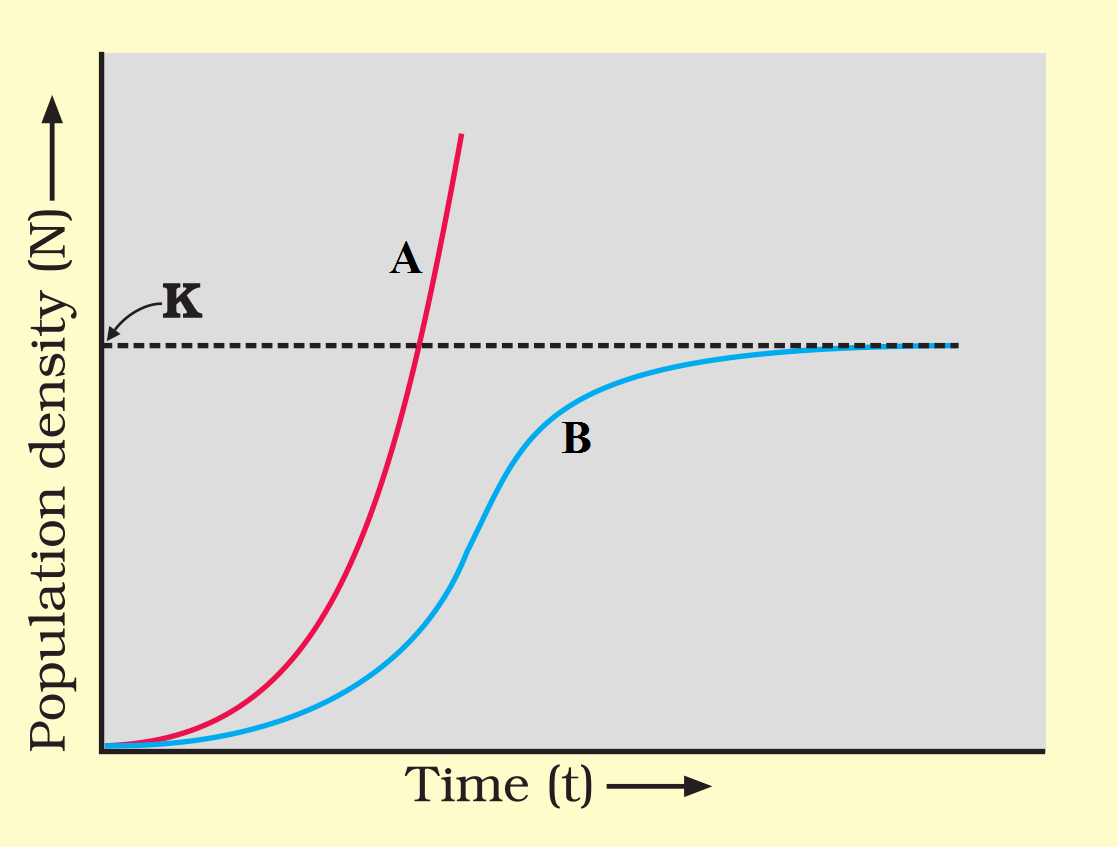
  1. Study the population growth curves (A and B) in the given graph and select the incorrect option.
  1. Curve 'A: shows exponential growth, represented by equation $\frac{\text{dN}}{\text{dt}}=\text{rN}$.
  2. Curve 'B' shows logistic growth, represented by equation $\frac{\text{dN}}{\text{dt}}=\text{rN}\Big(\frac{\text{K}-\text{N}}{\text{K}}\Big)$
  3. Exponential growth curve is considered as more realistic than the logistic growth curve.
  4. Curve 'A' can also be represented by equation $\text{N}_\text{t}=\text{N}_\text{o}\text{e}^\text{rt}$.
Differentiate between Monohybrid & Dihybrid Cross.
Read the following text carefully and answer the questions that follow:
Transgenic animals can serve as factories that in some cases, may produce large amounts of proteins more efficiently. Transgenic mice have been engineered to express human antibodies by introducing a large segment of human DNA encoding human immunoglobulin genes. In transgenic large animals such as cows or sheep proteins of pharmaceutical value can be produced in large quantities in milk which is later purified. Transgenes can be used to alter many phenotypic properties including growth rate, fat composition, milk production, hair texture, etc.
i. In transgenic animals, i.e. cow and sheep proteins of pharmaceutical value are produced in large quantities in which gland. (1)
ii. Why is mouse the most preferred animal for studies on gene transfer? (1)
iii. Why does the production of transgenic animals take place? (2)
OR
Assertion (A): Transgenic mice have been engineered to express human antibodies. (2)
Reason (R): Large segments of human DNA encoding human immunoglobulin have been transferred to mice.
a. Both A and R are true and R is the correct explanation of A.
b. Both A and R are true but R is not the correct explanation of A.
c. A is true but R is false.
d. A is false but R is true.
Explain innate immunity in detail
Read the following text carefully and answer the questions that follow:
After implantation, finger-like projections appear on the trophoblast called chorionic villi which are surrounded by the uterine tissue and maternal blood. The chorionic villi and uterine tissue become interdigitated with each other and jointly form a structural and functional unit between the developing embryo (foetus) and the maternal body.
Image
i. Name the hormone crucial in parturition. Does the parturition signal originate from the mother or the fetus?(1)
ii. When and where do chorionic villi appear in humans? (1)
iii. Woman has conceived and implantation has occurred. Discuss the impact of progesterone and estrogen. (2)
OR
Fetal ejection reflex leads to parturition. Justify (2)