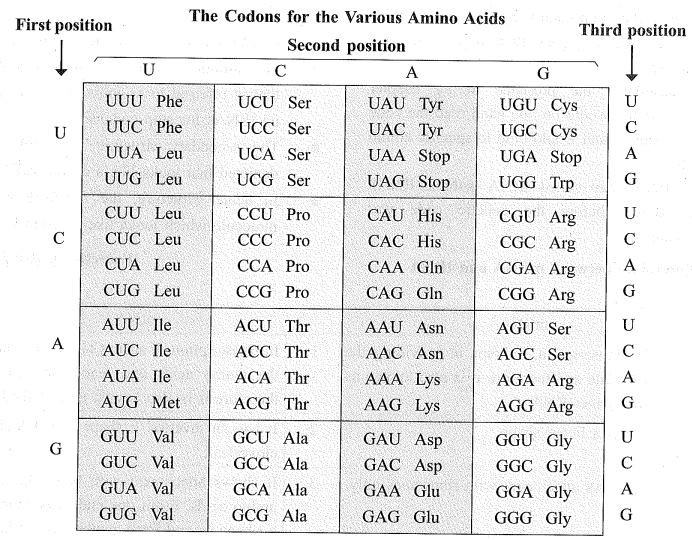
→ The genetic code can be defined as the set of certain rules using which the living cells translate the information encoded within genetic material (DNA or mRNA sequences). The ribosomes are responsible to accomplish the process of translation.
→ During replication and transcription a nucleic acid was copied to form another nucleic acid. Hence, these processes are easy to conceptualise on the basis of complementarity.
→ The process of translation requires transfer of genetic information from a polymer of nucleotides to synthesise a polymer of amino acids.
→ Neither does any complementarity exist between nucleotides and amino acids, nor could any be drawn theoretically.
→ There existed ample evidences, though, to support the notion that change in nucleic acids (genetic material) were responsible for change in amino acids in proteins.
→ This led to the proposition of a genetic code that could direct the sequence of amino acids during synthesis of proteins.
→ If determining the biochemical nature of genetic material and the structure of DNA was very exciting, the proposition and deciphering of genetic code were most challenging.
→ In a very true sense, it required involvement of scientists from several disciplines physicists, organic chemists, biochemists and geneticists.
→ It was George Gamow, a physicist, who argued that since there are only 4 bases and if they have to code for 20 amino acids, the code should constitute a combination of bases.
→ He suggested that in order to code for all the 20 amino acids, the code should be made up of three nucleotides.
→ This was a very bold proposition, because a permutation combination of 43 (4 x 4 x 4) would generate 64 codons; generating many more codons than required.
→ Providing proof that the codon was a triplet, was a more daunting task. The chemical method developed by Har Gobind Khorana was instrumental in synthesising RNA molecules with defined combinations of bases (homopolymers and copolymers)
→ Marshall Nirenberg's cell-free system for protein synthesis finally helped the code to be deciphered.
→ Severo Ochoa enzyme (polynucleotide phosphorylase) was also helpful in polymerising RNA with defined sequences in a template independent manner (enzymatic synthesis of RNA).