Question
What is hybridization? Describe sp³, sp² and sp hybridization with examples.

Answer

SELF

Need a full question paper?

Generate a complete, print-ready paper with questions like this in minutes — across 16+ boards, with answer keys.
Start Generating Free

Similar questions

  1. Sketch the following molecular shapes and give the various bond angles in the structure linear, triangular planar, tetrahedral and octahedral.
  2. What are the shapes of PCl5, NH3, BCl3, SF6, H2O, CCl4, SF4, ClF3, [BrF5]-, XeF4, XeF2
On the basis of Le Chatelier principle explain how temperature and pressure can be adjusted to increase the yield of ammonia in the following reaction:
$
\begin{aligned}
& N_2(g)+3 H_2(g) \rightleftharpoons 2 NH_3(g) \\
& \Delta H=-92.38 kJmol^{-1}
\end{aligned}
$
What will be the effect of the addition of argon to the above reaction mixture at constant volume?
The Mn3+ ion is unstable in solution and undergoes disproportionation to give Mn2+, MnO2, and H+ ion. Write a balanced ionic equation for the reaction.
Explain the formation of a chemical bond.
  1. Commercially available concentrated hydrochloric acid contains 45% HCl by mass.
  1. What is the molarity of this solution? The density is 1.19g mL.
  2. What volume of cone. HCl is required to make 1.00L of 0.24M HCl?
  1. Write the balanced chemical equations for the following:
  1. KMnO4 + NH3 → MnO2 +KOH+ H2O + N2
  2. HNO3 + P→ NO2 + H3PO4 + H2O
The first ionization constant of $H _2 S$ is $9.1 \times 10^{-8}$. Calculate the concentration of $HS ^{-}$ion in its 0.1 M solution. How will this concentration be affected if the solution is 0.1 M in HCl also? If the second dissociation constant of $H _2 S$ is $1.2 \times 10^{-13}$, calculate the concentration of $S ^{2-}$ under both conditions.
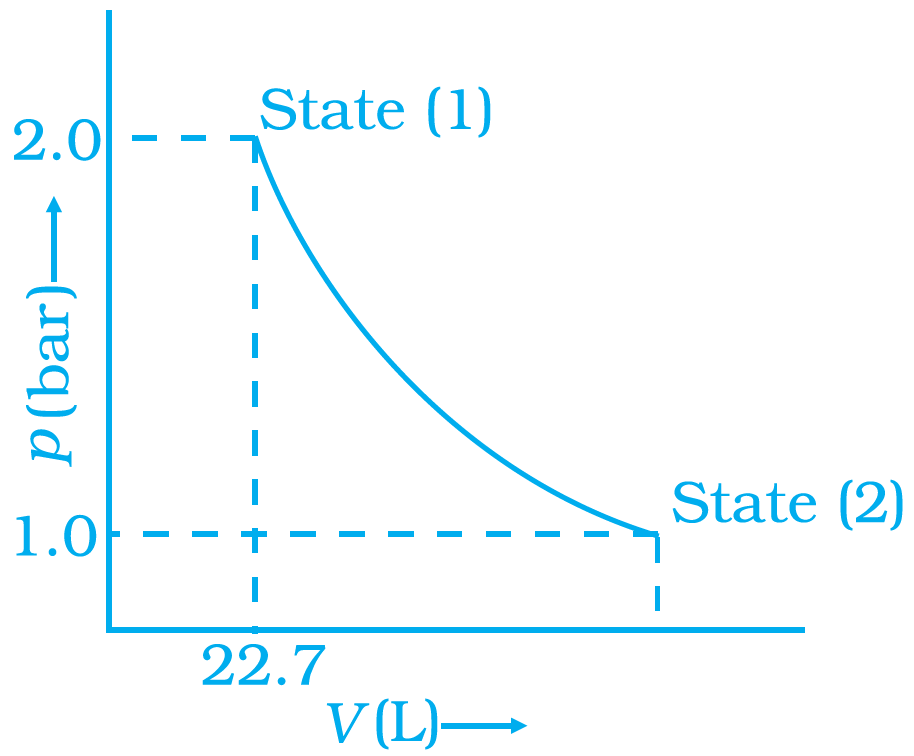
1.0 mol of a monoatomic ideal gas is expanded from state (1) to state (2) as shown in Fig. Calculate the work done for the expansion of gas from state (1) to state (2) at 298K.

What is conformational isomerism? Explain it with the help of ethane.
Explain in brief aromaticity.
Ethyl acetate is formed by the reaction of ethanol and acetic acid and the equilibrium is represented as:
$
CH_3 COOH(l)+C_5 H_5 OH(l) \rightleftharpoons CH_3 COOC_2 H_5(l)+H_2 O(l)
$
a. Write the concentration ratio (reaction quotient), $Q _{ C }$, for this reaction (note: water is not in excess and is not a solvent in this reaction)
b. At 293 K , if one starts with 1.00 mol of acetic acid and 0.18 mol of ethanol, there is 0.171 mol of ethyl acetate in the final equilibrium mixture. Calculate the equilibrium constant.
c. Starting with 0.5 mol of ethanol and 1.0 mol of acetic acid and maintaining it at $293 K, 0.214$ mol of ethyl acetate is found after some time. Has equilibrium been reached?