Gujarat BoardEnglish MediumSTD 12 ScienceChemistryCoordination Compounds4 Marks
Question
What is ligand? Explain classification of ligand.
✓
Answer
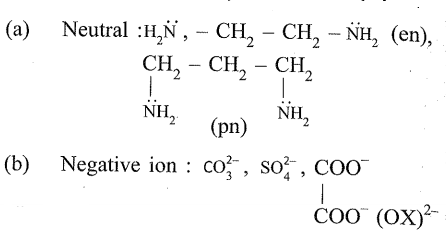
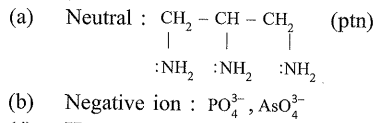
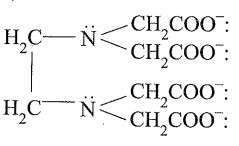
→ "Ligands are atom or ions which donates electron pairs to the central metal ion." (OR) → "The ions or molecules bound to the central atom/ion in the coordination entity are called ligands." → These may be simple ions such as Cl, small molecules such as H2O or NH3, larger molecules such as H2NCH2CH2NH2 or N(CH2CH2NH2)3 or even macromolecules, such as proteins. Classification of Ligands: (1) Unidentate ligands: → "When a ligand is bound to a metal ion through a single donor atom, the ligand is said to be unidentate." Example : (a) Neutral: $H _2 \ddot{ O }$, : $NH _3,: CO ,: NO , CH _3 \ddot{N}H_2, C _5 H _5\ddot{N}$ (py) (b) Negative ion: ${ }^{-} OH , F ^{-}, Cl ^{-}, Br ^{-}, I^{-} ,{ }^{-} CN , {}^{-}NH_2,$ $NO _3^{-}, NO _2^{-}, NCH _3 COO ^{-}\left( AcO ^{-}\right), O ^{2-}, S ^2, N^{3-}$ (2) Didentate ligands: → "When a ligand is bound to a metal ion through a two donor atom, the ligand is said to be didentate ". (3) Tridentate ligands: → "When a ligand is bound to a metal ion through a three donor atom, the ligand is said to be Tridentate," Example: (4) Hexadentate ligands: → When a ligand is bound to a metal ion through a six donor atom, the ligand is said to be hexadendate Example: Ethylenediaminetetraacetate ion $\left( EDTA ^{4-}\right)$
Need a full question paper?
Generate a complete, print-ready paper with questions like this in minutes — across 16+ boards, with answer keys.