Light Emitting Diode : The Light Emitting Diode, or LED, as it is more commonly called, is a diode which emits light when large forward current passes through it.
Working: An LED is forward-biased with about 1.2 V to 3.6 V at 12 mA to 20 mA. The majority of carriers electrons from the n-type layer and holes from the p-type layer are injected into the active layer. Electrons cross the junction into the player. In the active player, some of these excess minority carriers, electrons, recombine radiatively with majority carriers, holes, thereby emitting photons. The resulting photon has energy approximately equal to the bandgap of the active layer material. Modifying the bandgap of the active layer creates photons of different energies.
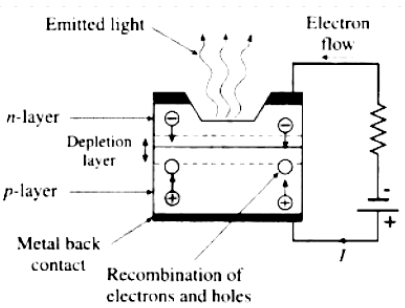 Working on an LED
In the energy band diagram, this recombination is equivalent to a transition of the electron from a higher energy state in the conduction band to a lower energy state in the valence band. The energy difference is emitted as a photon of energy hv.