Question
What is ‘liquidity trap’?
Answer

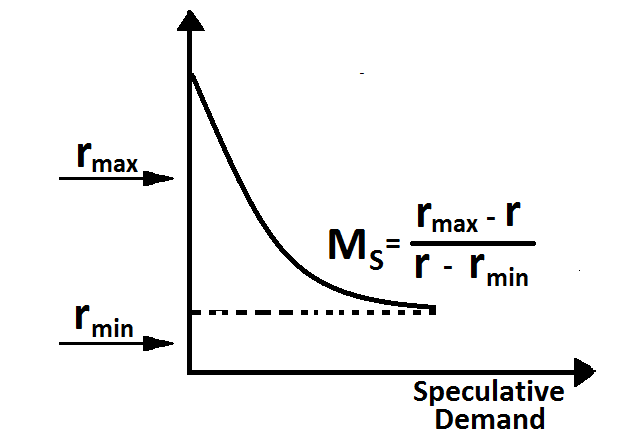
Liquidity trap is a situation in which speculative demand function is infinitely elastic; it is explained as follows: The price of a bond has an inverse relationship with the market interest rate. If the interest rate is very high and people expect it to fall in the future, then the bond prices will rise being inversely related to the interest rate. In order to earn capital gains in future, people will purchase bonds $($as bonds are cheaper$)$ and hence the speculative demand for money will become low. On the contrary, if the interest rate is low and people expect it to rise in future, then the bond prices will fall and in order to avoid capital loss, people will sell their bonds and convert their bonds into idle cash balances. Liquidity trap is an extreme case of the latter situation. When the interest rates are very low, then everyone expect interest rates to go up in future. Thus, to avoid capital loss, everybody prefers to maintain cash balance and not bond. Consequently, the speculative demand for money is infinitely elastic. In this situation, if the additional money is pumped into the economy, then, this will only satisfy the thirst for money, without increasing the demand for bonds. Pumping additional money in this situation will further exaggerate the condition as this will further reduce the interest rate below $\gamma$_{min}. The relationship between speculative demand for money and the rate of interest is given as:$\text{M}^{\text{d}}_\text{s}=\frac{\text{r}_{\text{max}}-\text{r}}{\text{r}-\text{r}_{\text{min}}}$

In the above diagram, interest rate is represented on the vertical axis and speculative demand on the horizontal axis. When $r = r$ min, the economy is in liquidity trap, where the speculative demand for money is infinite elastic.

Need a full question paper?

Generate a complete, print-ready paper with questions like this in minutes — across 16+ boards, with answer keys.

Start Generating Free

Similar questions

In the above question, calculate the effect on output of a 10 percent increase in transfers, and a 10 percent increase in lump-sum taxes. Compare the effects of the two.
Calculate:
  1. Gross domestic product at market price.
  2. National income.
    $(₹$ in crores$)$
$(i)$ Government final consumption expenditure $4,000$
$(ii)$ Private final consumption expenditure $3,500$
$(iii)$ Gross domestic capital formation $1,100$
$(iv)$ Net exports $500$
$(v)$ Net factor income from abroad $100$
$(vi)$ Net indirect taxes $300$
$(vii)$ Subsidies $40$
$(viii)$ Change in stock $80$
$(ix)$ Consumption of fixed capital $120$
What is the difference between direct tax and indirect tax? Explain the role of government budget in influencing allocation of resources.
In the above example, if exports change to X = 100, find the change in equilibrium income and the net export balance.
Explain the concept of 'inflationary gap'. Also, explain the role of 'legal reserves' in reducing it.
How is S and I approach derived from AD and AS approach of income determination. Use diagram.
Calculate national income and Gross national disposable income from the following:
 
 
(₹ Arab)
i.
Net current transfers to abroad
(-) 15
ii.
Private final consumption expenditure
600
iii.
Subsidies
20
iv.
Government final consumption expenditure
100
v.
Indirect tax
120
vi.
Net imports
20
vii.
Consumption of fixed capital
35
viii.
Net change in stocks
(-) 10
ix.
Net factor income to abroad
5
x.
Net domestic capital formation
110
Draw on a diagram a straight line savings curve for an economy. From it derive the consumption curve, explaining the method of derivation. Show a point on the consumption curve at which APC = 1?
The equilibrium level of income in an economy is ₹ 1,000 crore. The autonomous consumption expenditure is equal to ₹ 100 crore and investment expenditure ₹ 500 crore.Calculate:
  1. Consumption expenditure at equilibrium level of national income,
  2. Marginal Propensity to save,
  3. Saving Function;
  4. Break-even level of Income.
Currency is issued by the central bank, yet we say that commercial banks create money. Explain. How is this money creation by commercial banks likely to affect the national income? Explain.