Question
What is ‘liquidity trap’?
Answer

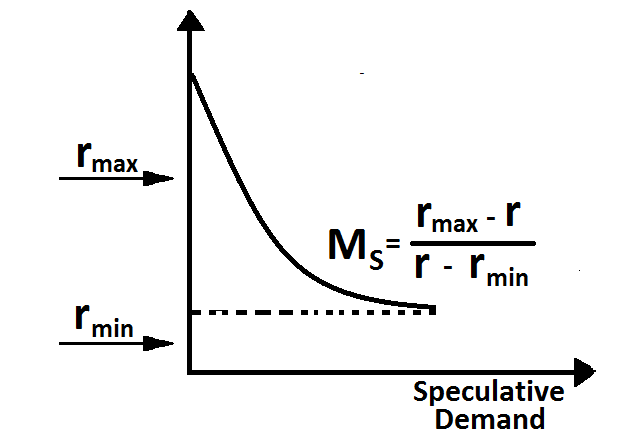
Liquidity trap is a situation in which speculative demand function is infinitely elastic; it is explained as follows: The price of a bond has an inverse relationship with the market interest rate. If the interest rate is very high and people expect it to fall in the future, then the bond prices will rise being inversely related to the interest rate. In order to earn capital gains in future, people will purchase bonds (as bonds are cheaper) and hence the speculative demand for money will become low. On the contrary, if the interest rate is low and people expect it to rise in future, then the bond prices will fall and in order to avoid capital loss, people will sell their bonds and convert their bonds into idle cash balances. Liquidity trap is an extreme case of the latter situation. When the interest rates are very low, then everyone expect interest rates to go up in future. Thus, to avoid capital loss, everybody prefers to maintain cash balance and not bond. Consequently, the speculative demand for money is infinitely elastic. In this situation, if the additional money is pumped into the economy, then, this will only satisfy the thirst for money, without increasing the demand for bonds. Pumping additional money in this situation will further exaggerate the condition as this will further reduce the interest rate below $\gamma_{min}$. The relationship between speculative demand for money and the rate of interest is given as:$\text{M}^{\text{d}}_\text{s}=\frac{\text{r}_{\text{max}}-\text{r}}{\text{r}-\text{r}_{\text{min}}}$

 In the above diagram, interest rate is represented on the vertical axis and speculative demand on the horizontal axis. When $r = r$ min, the economy is in liquidity trap, where the speculative demand for money is infinite elastic.

Need a full question paper?

Generate a complete, print-ready paper with questions like this in minutes — across 16+ boards, with answer keys.

Start Generating Free

Similar questions

From the following data calculate national income by (a) income method and (b) expenditure method:
S.No.   Rs.(in crores)
1 Private final consumption expenditure. 2,000
2 Net capital formation. 400
3 Change in stock. 50
4 Compenstation of employees. 1,900
5 Rent. 200
6 Interest. 150
7 Operating surplus. 720
8 Net indirect tax. 400
9 Employers' contribution to social security schemes. 100
10 Net exports. 20
11 Net factors income from abroad. -20
12 Government final consumption expenditure. 600
13 Consumption of fixed capital. 100
Define revenue receipts in a government budget. Explain how government budget can be used to bring in price stability in the economy.
Explain the consumption function with the help of schedule and diagram.
Derive the two alternative conditions of expressing national income equilibrium. Show these equilibrium conditions on a single diagram.
Giving reason explain how should the following be treated in estimation of national income:
  1. Expenditure by a firm on payment of fees to a chartered accountant.
  2. Payment of corporate tax by a firm.
  3. Purchase of refrigerator by a firm for own use.
Giving reasons explain how the following are treated while estimating national income:
  1. Payment of fees to a lawyer engaged by a firm.
  2. Rent free house to an employee by an employer.
  3. Purchases by foreign tourists.
How is S and I approach derived from AD and AS approach of income determination. Use diagram.
How will you treat the following while estimating domestic factor income of India? Give reasons for your answer.
  1. Remittances from non-resident Indians to their families in India.
  2. Rent paid by the embassy of Japan in India to a resident Indian.
  3. Profits earned by branches of foreign bank in India.
What are the alternative definitions of money supply in India?