Question
What is meant by coronary artery disease?

Answer

It is the hardening of arteries and arterioles due to the thickening of the fibres tissue and the consequent loss of elasticity. It is often referred to as atherosclerosis. This mainly affects the vessels, which are mainly responsible for supplying blood to the heart muscle. It seems to occur due to deposition of calcium, fat cholesterol, and fibrous tissues, making the lumen of arteries narrower
Need a full question paper?

Generate a complete, print-ready paper with questions like this in minutes — across 16+ boards, with answer keys.

Start Generating Free

Similar questions

What is the effect of pCO2 on oxygen transport?
Define differentiation? Also give details about how can you distinguish between dedifferentiation and redifferentiation?
Complete the following equation of conversion of pyruvic acid int acetyl coenzyme-A. Where does this process occur inside the cell?
$\text{Pyruvic acid}+\text{Co}-\text{A}+\ ...\xrightarrow[\text{pyruvate dehydrogenate}]{\text{Mg}^{2+}}\text{Acetyl}$
$\text{Acetyl}\text{ Co}-\text{A}+\ ...+\ ...$
What is the difference between direct and indirect development?
Distinguish anaphase of mitosis from anaphase I of meiosis.
Name the categories of plant hormones concerned with each of the following and describe one other function of each of the three categories of plant hormones.
  1. Inhibition of seed germination.
  2. Promote flowering.
  3. Cell division promoting activity.
What is stomatal apparatus? Explain the structure of stomata with a labelled diagram.
For completion of respiration process, write the given steps in sequential manner.
  1. Diffusion of gases (O2 and CO2) across alveolar membrane.
  2. Transport of gases by blood.
  3. Utilisation of O2 by the cells for catabolic reactions and resultant release of CO2 .
  4. Pulmonary ventilation by which atmos-pheric air is drawn in and CO2 rich alveolar air is released out.
  5. Diffusion of O2 and CO2 between blood and tissues.
Explain how hypothalamus functions as an endocrine gland?
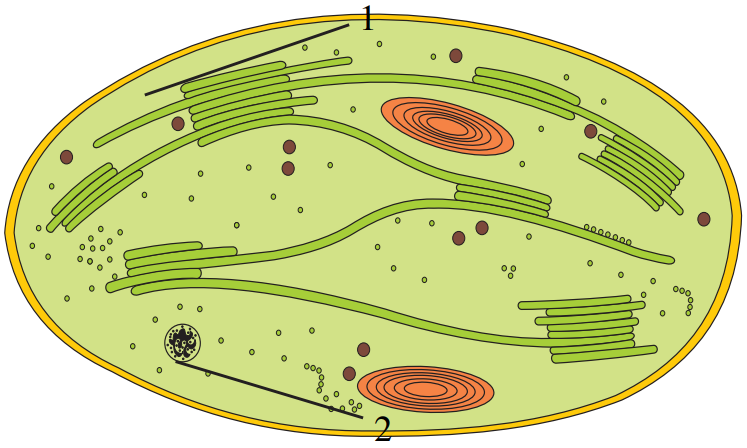
Examine the figure.

  1. Is this structure present in animal cell or plant cell?
  2. Can these be passed on to the progeny? How?
  3. Name the metabolic processes taking place in the places marked (1) and (2).