Question
What is meant by elastic potential energy? Derive an expression for the elastic potential energy of a stretched wire. Prove that its elastic energy density is equal to $\frac{1}{2}\text{stress}\times\text{strain}.$

Answer

When a wire is stretched, some work is done against the internal restoring forces acting between particles of the wire. This work done appears as elastic potential energy in the wire. Consider a wire of length l and area of cross-section a. Let F be the stretching force applied on the wire and $\Delta\text{l}$ be the increase in length of the wire. Initially, the internal restoring force was zero but when the length is increased by $\Delta\text{l},$ the internal force increases from 0 to F(applied force). Thus, average initial force on an increase in length $(\Delta\text{l},)$ of the wire, $=\frac{0+\text{F}}{2}=\frac{\text{F}}{2}.$ Hence, work done on the wire, W = Average force × Increase in length, $=\frac{\text{F}}{2}\times\Delta\text{l}$ This is stored as elastic potential energy U in the wire, $\therefore\text{U}=\frac{1}{2}\text{F}\times\Delta\text{l}=\frac{1}{2}\frac{\text{F}}{\text{a}}\times\frac{\Delta\text{l}}{\text{l}}\times\text{al}$ $=\frac{1}{2}(\text{Stress})\times(\text{Strain)}\times\text{Volume of the wire}$ $\therefore$ Elastic potential energy per unit volume of the wire is given by, $\text{u}=\frac{\text{U}}{\text{al}}=\frac{1}{2}\times\text{Stress}\times\text{Strain}$

Need a full question paper?

Generate a complete, print-ready paper with questions like this in minutes — across 16+ boards, with answer keys.
Start Generating Free

Similar questions

A family uses $8kW$ of power.
  1. Direct solar energy is incident on the horizontal surface at an average rate of $200W$ per square meter. If $20\%$ of this energy can be converted to useful electrical energy, how large an area is needed to supply $8kW$?
  2. Compare this area to that of the roof of a typical house.
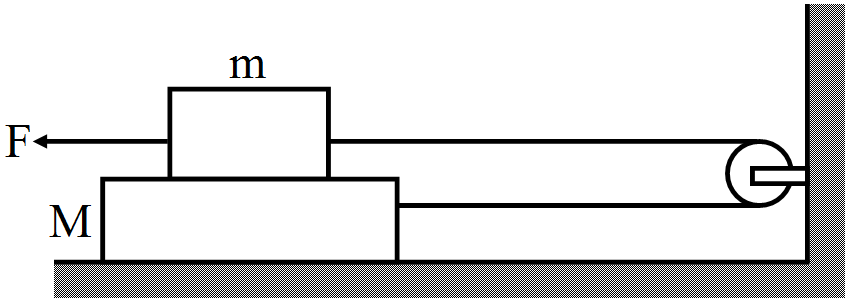
The friction coefficient between the two blocks shown in figure is $\mu$ but the floor is smooth.
  1. What maximum horizontal force F can be applied without disturbing the equilibrium of the system?
  2. Suppose the horizontal force applied is double of that found in part (a). Find the accelerations of the two masses.
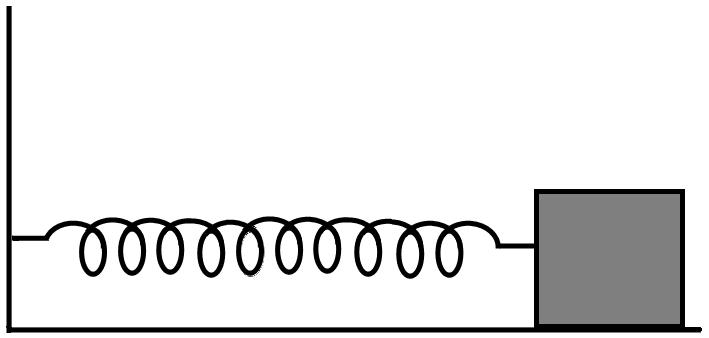
For three situations, the initial and final positions respectively, along x-axis for the block in Fig are (a) - 3cm, 2cm. (b) 2cm, 3 cm and (c) -2cm, 2cm. In each situation, is the work done by the spring force on the block positive, negative or zero?
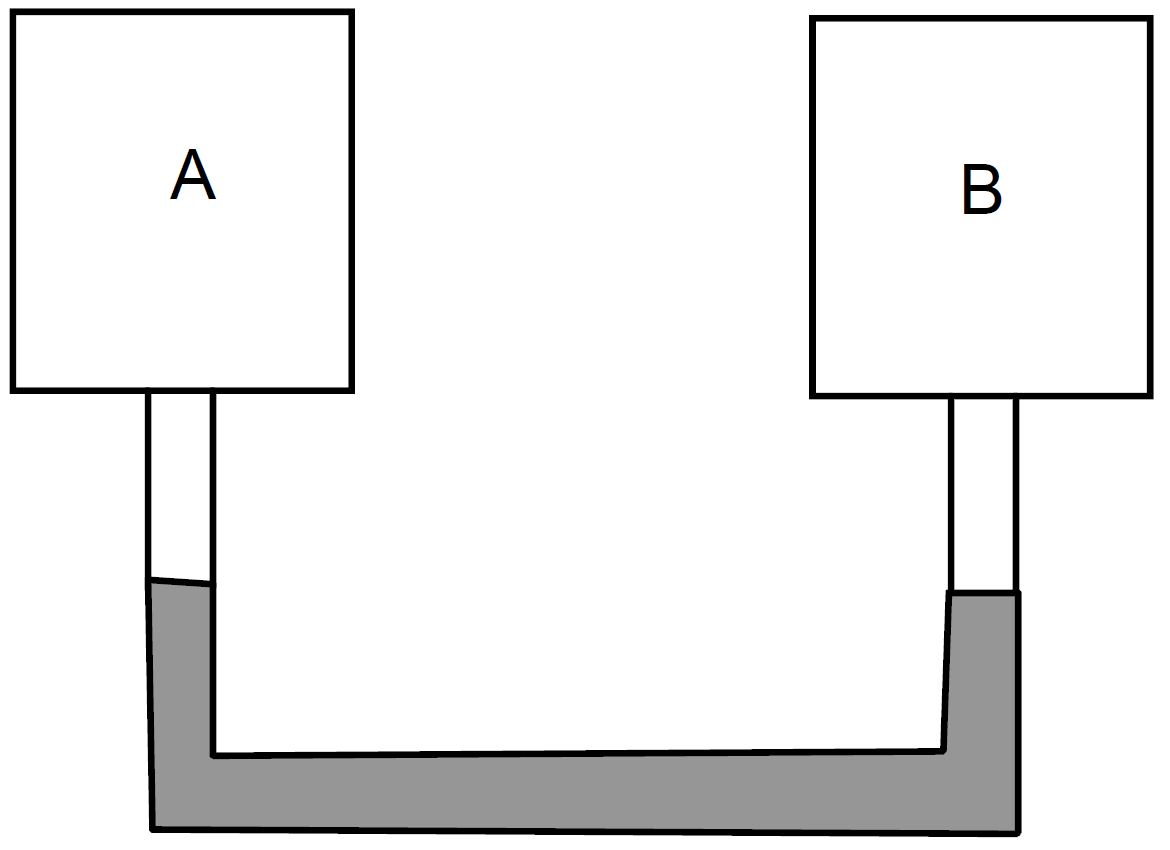
Figure shows two rigid vessels A and B, each of volume $200cm^3$, containing an ideal gas ($C_v = 12.5JK^{-1}mol^{-1}$). The vessels are connected to a manometer tube containing mercury. The pressure in both the vessels is $75cm$ of mercury and the temperature is $300K$.
  1. Find the number of moles of the gas in each vessel.
  2. 5.0J of heat is supplied to the gas in vessel A and 10J to the gas in vessel B. Assuming there's no appreciable transfer of heat from A to B, calculate the difference in the heights of mercury in the two sides of the manometer. Gas constant, $R = 8.3JK^{-1}mol^{-1}$.
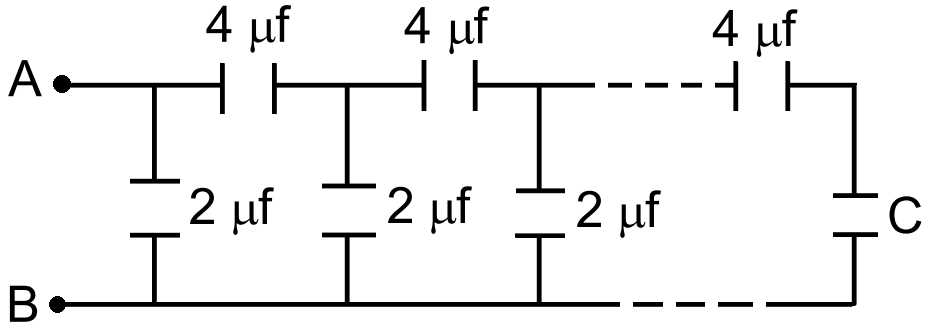
A finite ladder is constructed by connecting several sections of $2\mu\text{F},\ 4\mu\text{F}$ capacitor combinations as shown in figure. It is terminated by a capacitor of capacitance C. What value should be chosen for C, such that the equivalent capacitance of the ladder between the points A and B becomes independent of the number of sections in between?
Estimate the fraction of molecular volume to the actual volume occupied by oxygen gas at STP. Take the diameter of an oxygen molecule to be $3\mathring{\text{A}}$
A hole of radius $r_1$ is made centrally in a uniform circular disc of thickness d and radius $r_2$. The inner surface (a cylinder of length d and radius $r_1​​​​​​​$) is maintained at a temperature $\theta_1$ and the outer surface (a cylinder of length d and radius $r_2$) is maintained at a temperature $\theta_2(\theta_1>\theta_2).$ The thermal conductivity of the material of the disc is K. Calculate the heat flowing per unit time through the disc.
What is the excess pressure inside a bubble of soap solution of radius $5.00mm$, given that the surface tension of soap solution at the temperature $(20^\circ C)$ is $2.50 \times 10–2 Nm^{–1}$? If an air bubble of the same dimension were formed at depth of $40.0cm$ inside a container containing the soap solution (of relative density $1.20$), what would be the pressure inside the bubble? (1 atmospheric pressure is $1.01 \times 105Pa$).
The spectral energy distribution of the sun has a maximum at $4753\mathring{\text{ A}}$4753 Å. If temperature of sun is $6050\mathring{\text{ K }}.$ what is the temperature of a star for which this maximum wavelength is at $9506\mathring{\text{ A }}$
A particle slides on the surface of a fixed smooth sphere starting from the topmost point. Find the angle rotated by the radius through the particle, when it leaves contact with the sphere.