Question
What is meant by functional group? Give examples.
(OR)
Explain the term functional group with example.

Answer

The compound acquire specific chemical properties due to these hetero atoms or the groups of atoms that contain hetero atoms, irrespective of length and nature of the carbon chain in that compound. Therefore these hetero atoms or groups of atoms containing hetero atoms are called the functional groups.
Example: Methyl alcohol, acetic acid.
In methane $\left(\mathrm{CH}_4\right)$, when one hydrogen atom is replaced by an $-\mathrm{OH}$ group, methyl alcohol $\left(\mathrm{CH}_3 \mathrm{OH}\right)$, is formed. The $-\mathrm{OH}$ is known as the alcoholic functional group.
Similarly, from methane $\left(\mathrm{CH}_4\right)$ when one hydrogen atom is replaced by $-\mathrm{COOH}$ group, acetic acid $\left(\mathrm{CH}_3 \mathrm{COOH}\right)$ is formed. The $-\mathrm{COOH}$ group is known as the carboxylic acid functional group.

Need a full question paper?

Generate a complete, print-ready paper with questions like this in minutes — across 16+ boards, with answer keys.
Start Generating Free

Similar questions

They are not correct. The father with blood group A has genotype $I^AI^O.$ The mother with blood group $B$ has genotype $I^BI^O.$ Hence, the possible genotypes of the children will be $I^AI^B, I^AI^O, I^BI^O$ and $I^OI^O$. Thus, the possible blood groups of children will be $AB, A, B$ and $O.$ Hence, if the father has blood group A, and the mother has blood group $B, $ it is possible for them to have children with blood group O.
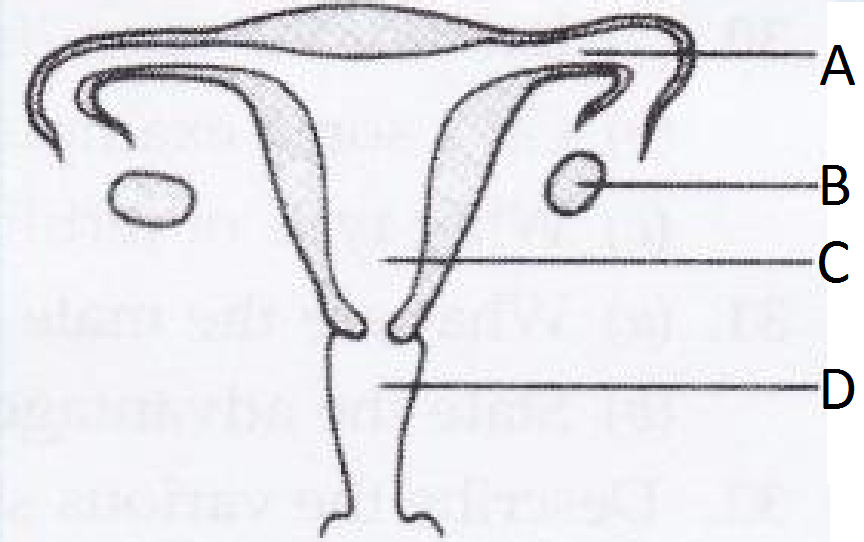
The diagram shows female reproductive system. Name the parts labelled A to D.
  1. In which part do the sperms enter?
  2. Which part releases the egg?
  3. In which part does fertilisation take place?
  4. In which part does the foetus develop?
An electric iron of 1100 W is operated for 2 hrs daily. What will be the electrical consumption expenses for that in the month of April? (The electric company charges Rs 5 per unit of energy).
A scientist removed some cells from the growing point of a plant and placed it in a suitable medium leading to the formation of a shapeless lump of mass X. X is then transferred to another medium which stimulates it to develop roots. When X with developed roots is placed in a yet another medium, then it develops shoots to form tiny plantlets. These plantlets can then be transplanted in pots or soil where they can grow to form mature plants.
  1. What is the shapeless lump of mass X known as?
  2. What name is given to this method of producing new plants?
  3. The growth medium used in this method contains plant nutrients in the form of a 'jelly'. Name this jelly.
  4. What is the general name of chemicals used to stimulate the growth of plant cells and development of roots and shoots?
  5. Name any two plants which are produced by this method.
  6. State any two advantages of this method of producing plants.
  7. What is the other name of this method [other then that given in (b) above]?
An object $3\ cm $ high is placed at a distance of 8cm from a concave mirror which produces a virtual image $4.5\ cm$ high:
  1. What is the focal length of the mirror?
  2. What is the position of image?
  3. Draw a ray-diagram to show the formation of image.
There is a pair of bean-shaped organs P in the human body towards the back, just above the waist. A waste product Q formed by the decomposition of unused proteins in the liver is brought into organ P through blood by an artery R. The numerous tiny filters S present in organ P clean the dirty blood by removing the waste product Q. The clean blood goes into circulation through a vein T. The waste substance Q, other waste salts, and excess water form a yellowish liquid U which goes from organ P into a bag-like structure V through two tubes W. This liquid is then thrown out of the body through a tube X.
  1. What is (i) organ P and (ii) waste substance Q?
  2. Name (i) artery R, and (ii) vein T.
  3. What are tiny filters S known as?
  4. Name (i) liquid U, (ii) structure V, (iii) tubes W and (iv) tube X.
Mendeleev predicted the existence of certain elements not known at that time and named two of them as eka - aluminium, and eka - silicon.
  1. Name the element which has taken the place of $(i)$ eka - aluminium, and $(ii)$ eka - silicon.
  2. Mention the period/ periods of these elements in the modern periodic table.
  3. Write the group/ groups of these elements in the modern periodic table.
  4. Classify these elements as metals, non - metals or metalloids.
  5. How many valence electrons are present in the atoms of each of these elements$?​​​​​​$
Sketch, labell and classify: Earthworm
What is the reaction called when oxidation and reduction take place simultaneously? Explain with one example.
When metal $X$ is treated with a dilute acid $Y$, then a gas $Z$ is evolved which burns readily by making a little explosion.
  1. Name any two metals which can behave like metal $X.$
  2. Name any two acids which can behave like acid $Y.$
  3. Name the gas $Z.$
  4. Is the gas $Z$ lighter than or heavier than air$?$
  5. Is the reaction between metal $X$ and dilute acid $Y,$ exothermic or endothermic$?$
  6. By taking a specific example of metal $X$ and dilute acid $Y,$ write a balanced chemical equation for the reaction which takes place. Also indicate physical states of all the reactants and products.