What is meant by (i) homogeneous mixtures, and (ii) heterogeneous mixtures? Give two examples of homogeneous mixtures and two of heterogeneous mixtures.
Download our app for free and get started
- Homogeneous mixtures: Those mixtures in which the substance are completely mixed together and are indistinguishable from one another, are called homogeneous mixtures.
- Heterogeneous mixtures: Those mixtures in which the substances remain separate and one substance is spread throughout the other substance as small particles, droplets or bubbles, are called heterogeneous mixtures.

Download our appand get started for free
Experience the future of education. Simply download our apps or reach out to us for more information. Let's shape the future of learning together!No signup needed.*
Similar Questions
- 1View SolutionDescribe a method of separate a mixture of common salt and sand.
- 2View SolutionState one property in which a solution of sugar in water resembles a mixture of sugar and sand, and one property in which it differs from it.
- 3View SolutionGive an example each for the mixture having the following characteristics. Suggest a suitable method to separate the components of these mixtures: Two volatile components with appreciable difference in boiling points.
- 4View SolutionDescribe a method to separate a mixture of camphor and sand.
- 5View SolutionClassify the following into solution, suspensions and colloids: Soda-water, Milk, Brine, Blood, Ink, Smoke in air, Chalk water mixture, Milk of Magnesia, Shaving cream, Muddy river water.
- 6View SolutionWhat is a mixture? Give two example of mixtures.
- 7View SolutionWhat is meant by a solution? Give two examples of solutions.
- 8View SolutionClassify the substances given in into elements and compounds:
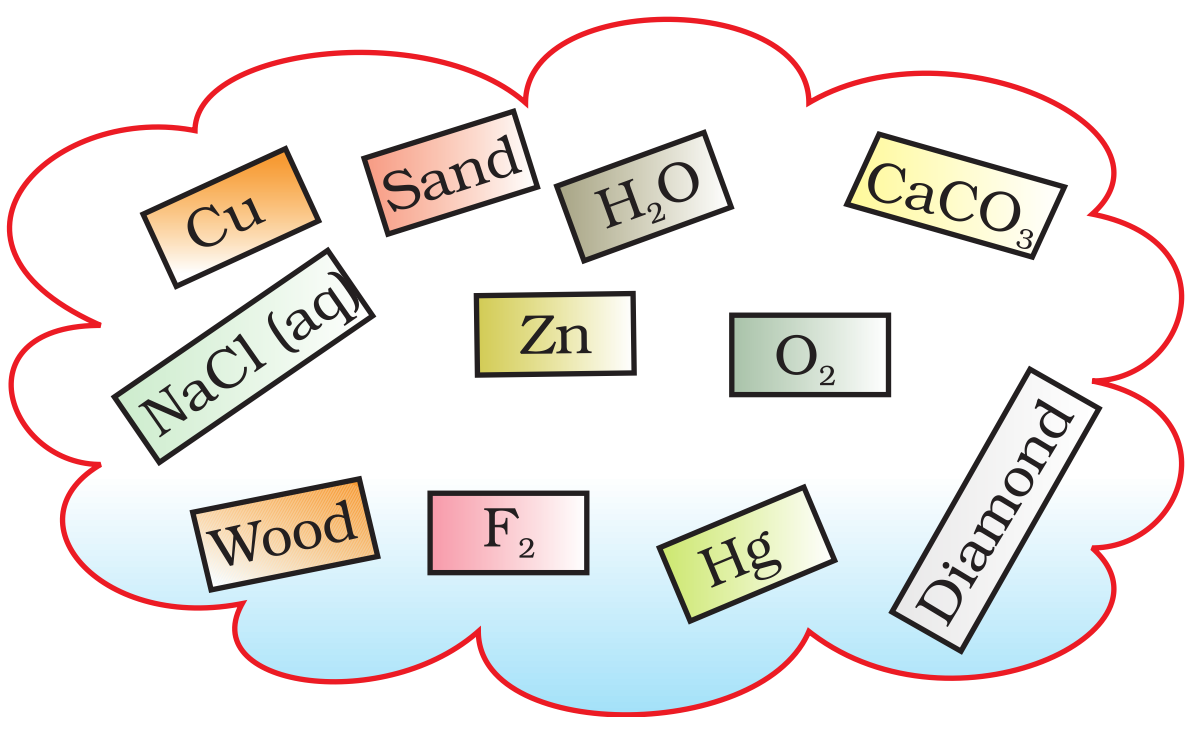
- 9View SolutionWhich of the following are not compounds?
- Chlorine gas
- Potassium chloride
- Iron
- Iron sulphide
- Aluminium
- Iodine
- Carbon
- Carbon monoxide
- Sulphur powder
- 10If $25\ ml$ of acetone is present in $150\ ml$ of its aqueous solution, calculate the concentration of solution.View Solution