Question
What is meant by microorganisms in industrial products? How do microorganisms help us in making beverages? Explain.

Answer

Microorganisms in Industrial Products : Microorganisms are used in industries to manufacture many products which are valuable to humans. Alcoholic beverages and antibiotics are some examples of this. To grow microorganisms on a commercial scale, a large vessel is required which is called a fermenter.
Microorganisms, especially yeast, have been used since ancient times in the production of beverages like wine, beer, whiskey, rum. To fulfill this purpose, yeast Saccharomyces cerevisiae is used to making bread and producing ethanol from malted grains and fruit juices. Fermentation and various types of processing (with or without distillation) depend on the raw materials. Production of wine and beer without distillation; whereas whiskey, brandy and rum are prepared by distillation of fermented juice.
Need a full question paper?

Generate a complete, print-ready paper with questions like this in minutes — across 16+ boards, with answer keys.

Start Generating Free

Similar questions

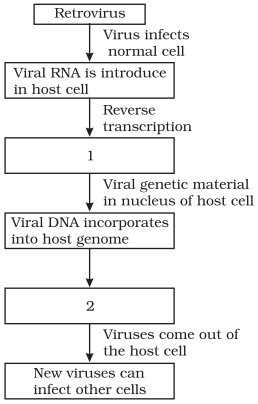
In the given flow diagram, the replication of retrovirus in a host is shown. Observe and answer the following questions,

  1. Fill in (1) and (2).
  2. Why is the virus called retrovirus?
  3. Can the infected cell survive while viruses are being replicated and released?

  1. Explain with the help of Griffith’s experiment how the search for genetic material was conducted and what was the conclusion drawn?
  2. How did MacLeod, McCarty and Avery establish the biochemical nature of the so called ‘genetic material’ identified by Griffith in his experiment.
Describe the functions of the following:
Seminiferous tubules.
Work out a typical Mendelian dihybrid cross and state the law that he derived from it.
Samya visited a zoo with her mother, on watching the cheetah, she wondered how he uses his forelimbs for running. While the same forelimbs in bats are used for flying. She wanted to know more about it and so asked her mother (a biology teacher) about it. Her mother explained her how forelimbs are modified in different animal groups for different functions.
  1. What are such organs called?
  2. Give an example of such organs from the plant world.
  3. What led to the origin of such organs?
  4. What are the values shown by Samya?
Define decomposition and describe the processes and products of decomposition.
Write the name of any one water-borne disease. Explain the measures to prevent water-borne diseases.
Read the following and answer any four questions from (i) to (v) given below:

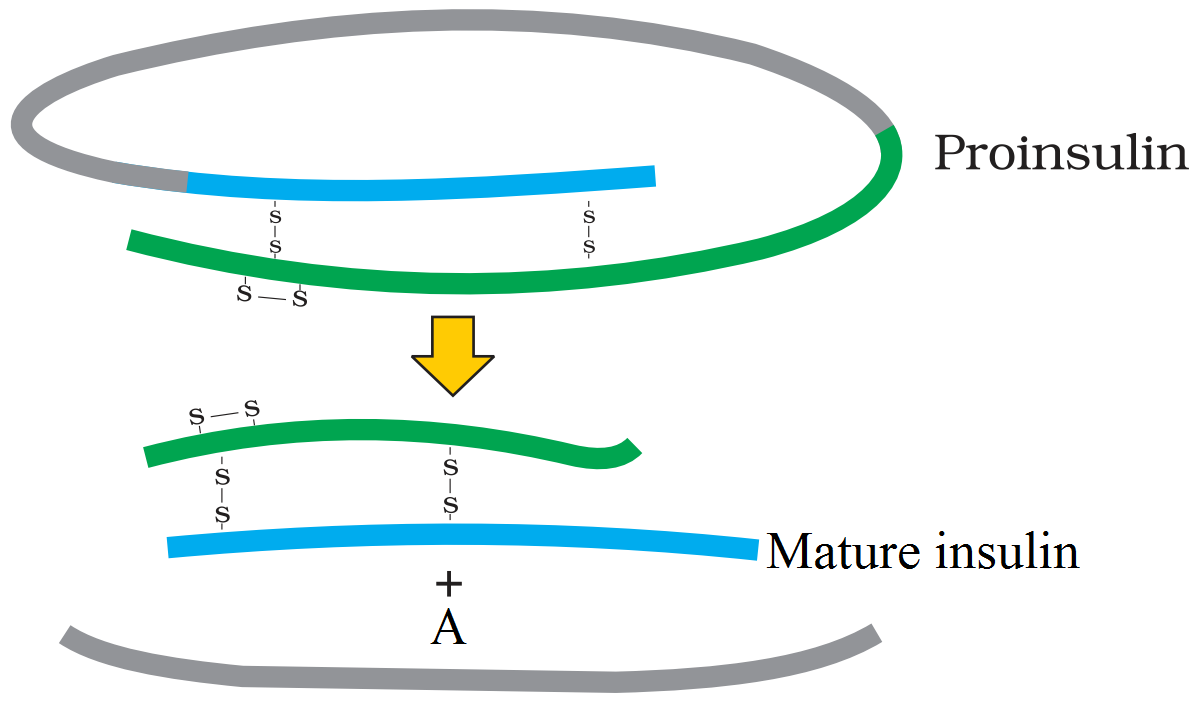
Insulin used to cure diabetes was earlier extracted from pancreas of slaughtered cattle and pigs. Insulin extracted from an animal source, though caused some patients to develop allergy or other types of reactions to the foreign protein. Human insulin consists of two short polypeptide chains : chain A and chain B, that are linked together by disulphide bridges. In mammals including humans, insulin is synthesised as a pro-hormone which contains an extra stretch called the C-peptide. This C peptide is not present in mature insulin and is removed during maturation into insulin.

  1. Identify A in the given figure.

  1. Polypeptide chain A.
  2. Polypeptide chain B.
  3. Polypeptide chain C.
  4. None of these.
  1. The following is a list of some stages involved in producing human insulin from genetically engineered bacteria.
  1. The bacteria are cultured in a fermenter for large scale production.
  2. Recombinant insulin is extracted from the bacterial cells that expresses insulin gene.
  3. The same restriction enzyme is used again to cut the bacterial plasmid for insertion of the human insulin gene.
  4. Bacteria take up the plasmid carrying the insulin gene.
  5. A restriction enzyme is used to cut human DNA to extract the insulin gene.

Select the correct order of these stages.

  1.  1, 5, 3, 4, 2
  2. 2, 4, 3, 5, 1
  3. 4, 5, 3, 2, 1
  4. 5, 3, 4, 1, 2
  1. To insert the insulin gene into bacterial DNA, both the bacterial plasmid and the human chromosome containing the insulin gene are treated with the same restriction enzyme. Using the same restriction enzyme ensures that
  1. DNA ligase is able to join the segments of human and bacterial DNA.
  2. The exact length of nucleotides matching the insulin gene is removed from the plasmid.
  3. Both the bacterial and human DNA will contain sticky ends.
  4. Sticky ends in the cut plasmid and insulin gene are complementary.
  1. Why is the fermentor important for the production of human insulin by transgenic bacteria?
  1. It provides optimal conditions for the transgenic to multiply rapidly.
  2. It facilitates the extraction and purification of insulin from the transgenic bacteria.
  3. It maximise the rate of fermentation of the transgenic bacteria.
  4. It provides the low-oxygen conditions that are important for insulin production.
  1. A bacteriologist carries out his first attempt at engineering E.coli with the gene for human insulin. During the process, he realises that his stock of DNA ligase has depleted but decides to continue anyway. What is a likely consequence of his decision?
  1. Bacteria with the rDNA will not be able to form colonies in a fermenter.
  2. The resulting plasmids are not able to enter the E.coli bacteria even after applying heat shock.
  3. The resulting E.coli bacteria do not contain the human insulin gene.
  4. The bacterial plasmids do not have sticky ends and are unable to accommodate the human gene.
  1. Describe the characteristics a cloning vector must possess.
  2. Why DNA cannot pass through the cell membrane? Explain. How is a bacterial cell made ‘competent’ to take up recombinant DNA from the medium?
Explain spermatogenesis.