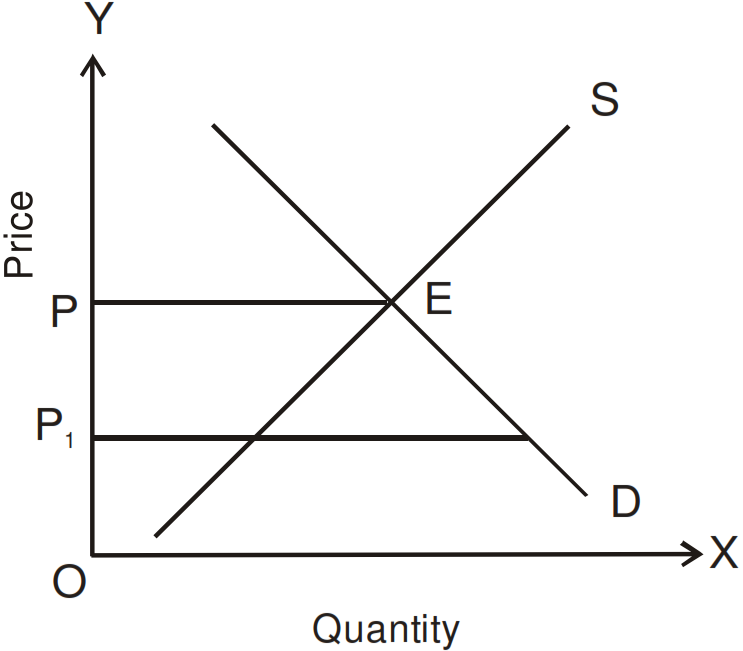
Question
What is meant by price ceiling? Explain its implications.

Need a full question paper?

Generate a complete, print-ready paper with questions like this in minutes — across 16+ boards, with answer keys.

Start Generating Free

Similar questions

The demand function of a commodity x is Qx = 12 - P. (where Qx = the quantity demanded of a commodity x and Px = price of the commodity x). Derive the TR and MR schedules when the price of commodity varies from ₹ 12 to ₹ 1.
How does change in price of a complementary good affect the demand of the given good? Explain with the help of an example.
Why does marginal cost eventually rise as output increases?
Draw a production possibility curve. What does a point below this curve indicate? Explain.
Read the passage given below and answer the following questions from 1 to 4.

India has scaled back expenditure, including on productive assets that aid economic growth, as the government is confronted with the risk of its budget deficit blowing out. Capital expenditure-the money spent on creating, maintaining or improving fixed assets like roads and factories-Stood at 40% of the budgeted amount in the six months to September, down from 55.5% in the year-ago period, data from the government's Controller General of Accounts show. The overall spending during the period was 49% of the budget aim compared to 53% last year. That's despite Prime Minister Narendra Modi's Government outlining measures worth more than 21 trillion rupees (281 billion) to counter the economic and social fallout of the Covid-19 outbreak. A closer look at the numbers shows the bulk of the spending was directed towards the poor and the farmers, with crucial sectors such as coal, power, shipping and steel receiving less than a third of their annual budget allocation. Spending on capital assets has so far trailed the so-called revenue expenditure that includes interest payments and overheads such as salaries, the data released last week showed. Modi's Government placed spending curbs on some ministries from April through December to manage its cash flow.

Source: Business Standard, Nov. 5, 2020

  1. Capital expenditure of the government ............ the assets of the government:
  1. Increases
  2. Decreases
  3. Both [a] and [b]
  4. None of these
  1. Expenditure on health due to Covid-19 is ............ expenditure of the government.
  1. Direct
  2. Revenue
  3. Both [a] and [b]
  4. None of these
  1. The overall spending has......... as compared to last year.
  1. Increased
  2. Decreased
  3. Both [a] and [b]
  4. None of these
  1. A closer look at the numbers shows the bulk of spending was directed towards the poor and the.............?
  1. Farmers
  2. Labour
  3. Manager
  4. None of these


What happens when the government fixes the maximum price (or price ceiling) lower than the market equilibrium price for the commodity? Explain with the help of a diagram.###Explain the effects of a 'Price Ceiling'.
Distinguish between (i) Fixed cost and variable cost giving examples and (ii) Average cost and marginal cost giving an example.
Calculate Gross National Product at Factor Cost by,
  1. Income method.
  2. Expenditure method from the following data:
S.No.
Contents
(in crore)
(i)
Net Domestic Capital Formation
500
(ii)
Compensation of Employees
1,850
(iii)
Consumption of Fixed Capital
100
(iv)
Government Final Consumption Expenditure
1,100
(v)
Private Final Consumption Expenditure
2,600
(vi)
Rent
400
(vii)
Dividend
200
(viii)
Interest
500
(ix)
Net Exports
(-)100
(x)
Profit
1,100
(xi)
Net Factor Income from Abroad
(-)50
(xii)
Net Indirect Taxes
250
A consumer spends continues to spend ₹ 1000 on a good priced at ₹ 8 per unit. When price rises by 25 percent, the consumer ₹ 1000 on the good. Calculate price elasticity of demand by percentage method.
A consumer spends ₹ 100 on a good priced at ₹ 4 per unit. When its price falls by 25 percent, the consumer spends ₹ 75 on the good. Calculate the price elasticity of demand by the Percentage method.