Question
What is meant by price ceiling? Explain its implications.
Answer

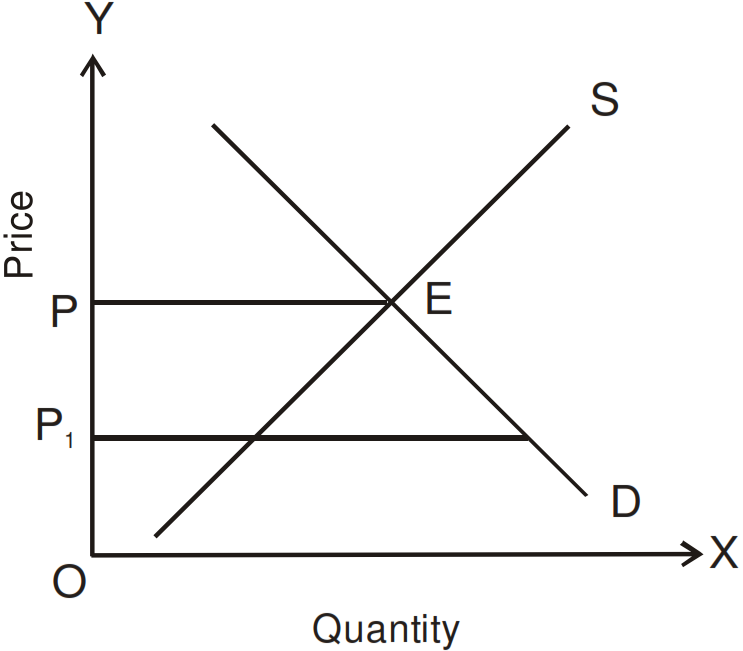
Price ceiling means, fixing the price of commodity by government below the equilibrium price to benifit the consumers (when the equilibrium price is presumed to be too high so that the common buyer is unable to afford such commodities at that price). Sometimes the equilibrium price determined $(OP)$ by the independent powers of demand and supply may be very high, so that most of the consumers are unable to purchase this commodity at the prevailling prices, specially in the case of necessary commodities like wheat, sugar, rice etc.

In those cases government directly interfere in price determination and decide the price $(OP_1)$ of the commodity below the equilibrium price. This price is also known as control price. In this condition government decides the maximum limit of price. At this price level the quantity demanded is more than the quantity supplied.
The implication of Price Ceiling is as follows:
  1. Shortage: Control price are lesser than equilibrium price, therefore sellers wants to sale less of the commodity whereas consumers wants to purchase more of the commodity, which creates the problem of shortage in market.
  2. Hoarding and Black Marketing: Because control price is lesser than the equilibrium price which will decrease the profit margin of sellers, therefore they will try to hoard the commodity as much as possible. Due to shortage and rationing some buyer will try to purchase more units by giving higher prices than control price, which lead to black-marketing.

Need a full question paper?

Generate a complete, print-ready paper with questions like this in minutes — across 16+ boards, with answer keys.

Start Generating Free

Similar questions

What does the law of variable proportions show? State the behaviour of marginal product according to this law.
OR
State the different phases of law of returns to a factor in terms of behaviour of marginal product. Represent the same in the diagram.
OR
State the likely behaviour of marginal product under the law of variable proportions.
OR
Explain the law of variable proportions in terms of marginal product with the help of a diagram.
OR
Prepare a marginal product schedule when for increasing production only one input is increased. Indicate the phases of law of variable proportions.
Comment upon the shape of the demand curve if the price of a commodity rises by $10\%$ and there is no change in its quantity demanded.
A $5%$ rise in price of a good leads to $5%$ fall in its demand. A consumer buys 100 units of a good when price is ₹ $5$ per unit. At what price will he buy $120$ units? Calculate.
What does the price elasticity of supply mean? How do we measure it?
Calculate TVC and MC at each given level of output from the following table:
Output (Units)
0
1
2
3
4
Total Cost ()
40
60
78
97
124
Given the price of a good, how does a consumer decide as to how much of that good to buy.
Or
Explain the condition of determining how many units of a good consumer will buy at a given price.
OR
Explain why the price a consumer is willing to pay for a good equals the marginal utility of X when in equilibrium.
OR
Explain why consumer's equilibrium is attained when the utility of a product in terms of money is equal to its price.
Calculate Average Revenue (AR) and Marginal Revenue (MR):
Units Sold 1 2 3 4 5 6 7
TR (₹) 20 36 48 56 60 60 56
What is the value of the MR when the demand curve is elastic?
A producer supplies 80 units of a good at a price of Rs. 10 per unit. Price elasticity of supply is 4. How much will he supply at Rs. 9 per unit?
Give reasons for the following statements:
  1. Demand curve facing a perfectly competitive firm is a horizontal straight line.
  2. Demand curve facing a monopolistic competitive firm is a downward sloping curve.
  3. Demand curve facing a monopoly firm is less elastic than that curve facing a monopolistic competitive firm.