Question
What is mycorrhiza? Write its main advantages.

Answer

Mutual symbiosis of fungi and roots of higher plants is called mycorrhiza. Under this process, the fungus completely forms a cover around the outside of the root of the plants with its fibers. Fungal filaments enter the intercellular space between the cortex cells of the plant root and form a net-like structure called hartig net. There are no root hairs on the root of the plant. The main function of the fungal root is to aid in the absorption of mineral salt (phosphorus). The absorption area of the root increases due to the fungus.
Main advantages of Mycorrhiza :
1. Resistance to root-borne pathogens.
2. Fungal roots increase the fertility of the soil.
3. Due to fungal root, the growth of the plants gets faster and production increases.
4. Absorption of mineral salts and other nutrients takes place easily and in large amount. That's why plants does not have to depend on external nutrients.
5. Synthesis of O2 increases.
6. The absorption surface increases due to the fungus in the mycellium.
7. This relationship is necessary for seed germination in some plants.
8. Due to fungal root, the plant’s dependency on fertilizers is reduced and the money can be saved.
9. Tolerence towards salinity and drought increases in the plant.
10. Pine plant sometimes rot away in lacking of fungal relationship, hence this relationship is helpful in forest construction.
11. Due to ectotrophic fungal root, many plants do not get infected by pythium, phytophthora, fusauum etc.
Need a full question paper?

Generate a complete, print-ready paper with questions like this in minutes — across 16+ boards, with answer keys.

Start Generating Free

Similar questions

Write notes on ex-situ conservation of biodiversity
More than 25% of human population is suffering from hunger and malnutrition. Scientists have developed techniques where microbes are grown on industrial scale as a source of good protein which can be grown from waste water, animal manure and even sewage.
Based on the above information answer the following questions.
  1. In what ways would it be helpful to humans?
  2. What can be the response to such new ventures?
  3. What values have been manifested in the above case?
Rohan and his friends emptied all the overhead tanks, which were not in use for last few months. Some people did not like this. Rohan and his friends explained and convinced them about the hygienic benefits of their act.
  1. What was the objective behind their act?
  2. Explain in brief the stages of life cycle of a malarial parasite in human body.
  3. Which pathogen is responsible for malaria?
  4. What values did Rahul and his friends promote?
(i) Write full name of AIDS.
(ii) Write four ways of transmission of HIV infection.
(iii) Write a way to prevent HIV infection.
  1. In humans, males are heterogametic and females are homogametic. Explain. Are there any examples where males are homogametic and females heterogametic?
  2. Also describe as to, who determines the sex of an unborn child? Mention whether temperature has a role in sex determination.
Explain the difference between prokaryotic and eukaryotic DNA.
A youth in his twenties met with an accident and succumbed to the injuries. His parents agreed to donate his organs. So, their:
  1. List any two essential clinical steps to be undertaken before any organ transplant.
  2. Why is the transplant rejected sometimes?
  3. What views would you share with your health club members to promote organ donation?
"It is often said that the pyramid of energy is always upright. On the other hand, the pyramid of biomass can be both upright and inverted." Explain with the help of examples and sketches.
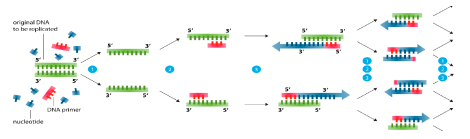
Polymerase chain reaction (PCR) is a laboratory technique used to amplify DNA sequences. The method involves using short DNA sequences called primers to select the portion of the genome to be amplified. The temperature of the sample is repeatedly raised and lowered to help a DNA replication enzyme copy the target DNA sequence. The technique can produce a billion copies of the target sequence in just a few hours.
Image
i. List the three steps involved in Polymerase Chain Reaction (PCR).
ii. Name the source organism of Taq polymerase.
iii. Explain the specific role of this enzyme in PCR.
a. Where is microsporangium located in an angiosperm? State the functions of tapetum and the other three layers of microsporangium.
b. Describe the structure of the male gametophyte produced as a result of microsporogenesis.
c. State the functions of each part of the male gametophyte.