- AThe PD between any two points on the surface is zero.
- BThe electric field is always perpendicular to the surface.
- CEquipotential surfaces are always spherical.
- DNo work is done in moving a charge along the surface.
Explanation:
Equipotential surface
→ P.D difference between two points on the surface is zero always since potential is same everywhere in equipotential surface.
→ The EF is always perpendicular to the surface because there is no potential gradient along any direction parallel to the surface P so no EF parallel to the surface
→ Equipotential surface can have any shape not just sphere.
→ No work is done in moving a charge along the surface, because potential difference is zero.
Generate a complete, print-ready paper with questions like this in minutes — across 16+ boards, with answer keys.
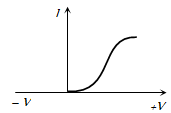
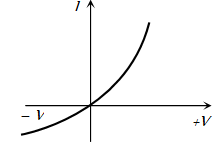
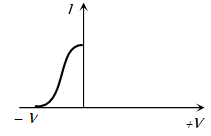
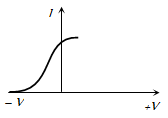
Different voltages are applied across a P-N junction and the currents are measured for each value. Which of the following graphs is obtained between voltage and current
(a)
|
(b)
|
(c)
|
(d)
|
A capacitor is connected to a cell of emf E having some internal resistance r. The potential difference across the
|
(a) Cell is < E |
(b) Cell is E |
(c) Capacitor is > E |
(d) Capacitor is < E |
An α- particle travels in a circular path of radius 0.45 m in a magnetic field B = 1.2 with a speed of 2.6
. The period of revolution of the α - particle is
|
(a) 1.1 |
(b) 1.1 |
(c) 1.1 |
(d) 1.1 |
A student has 10 resistors of resistance ‘r’. The minimum resistance made by him from given resistors is
|
(a) 10 r |
(b) |
(c) |
(d) |
A beam with wavelength
falls on a stack of partially reflecting planes with separation d. The angle q that the beam should make with the planes so that the beams reflected from successive planes may interfere constructively is (where n = 1, 2, ……)
|
(a) |
(b) |
(c) |
(d) |
If an electron jumps from 1st orbital to 3rd orbital, then it will
|
(a) Absorb energy |
(b) Release energy |
|
(c) No gain of energy |
(d) None of these |