Question
What is nuclear binding energy?

Answer

Nuclear binding energy : When nuclear particles interact under nuclear forces, then work is done by the system through strong nuclear interaction and the system attains a bound state. The energy that is released in this process to achieve this bound state is obtained through mass defect. This is nuclear binding energy. The total binding energy of any nucleus depends on the number of nucleons present and the value of per-nucleon binding energy $\left(\frac{\Delta E }{ A }\right)$ represents the stability of the nucleus.
Therefore, Per nucleon binding energy
$\begin{array}{l}
=\frac{\text { Binding energy }}{\text { Mass number }} \\
=\frac{\Delta E}{A}=\frac{(\Delta m) c^2}{A} \text { joule }
\end{array}$
If mass is expressed as a.m.u. then binding energy
$=(\Delta m) \times 931 MeV$
Per nucleon binding energy
$=(\Delta m) \times 931 MeV$
Per nucleon binding energy
$=\frac{(\Delta m) \times 931}{A} MeV / \text { nucleon }$

Need a full question paper?

Generate a complete, print-ready paper with questions like this in minutes — across 16+ boards, with answer keys.
Start Generating Free

Similar questions

A particle of mass ‘m’, with charge ‘q’ moving with a uniform speed ‘v’, normal to a uniform magnetic field ‘B’, describes a circular path of radius ‘r’. Derive expressions for the:
  1. Time period of revolution.
  2. Kinetic energy of the particle.
The kinetic energy of a charged particle decreases by 10J as it moves from a point at potential 100V to a point at potential 200V. Find the charge on the particle.
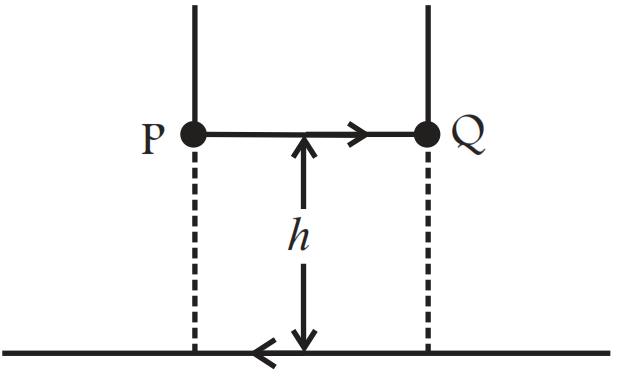
A long straight wire carrying current of 25A rests on a table as shown in Fig. Another wire PQ of length 1m, mass 2.5g carries the same current but in the opposite direction. The wire PQ is free to slide up and down. To what height will PQ rise?

A human body excretes (removes by waste discharge, sweating, etc.) certain materials by a law similar to radioactivity. If technetium is injected in some form in a human body, the body excretes half the amount in 24 hours. A patient is given an injection containing 99Tc. This isotope is radioactive with a half-life of 6 hours. The activity from the body just after the injection is $6\mu\text{Ci}.$ How much time will elapse before the activity falls to $3\mu\text{Ci}?$
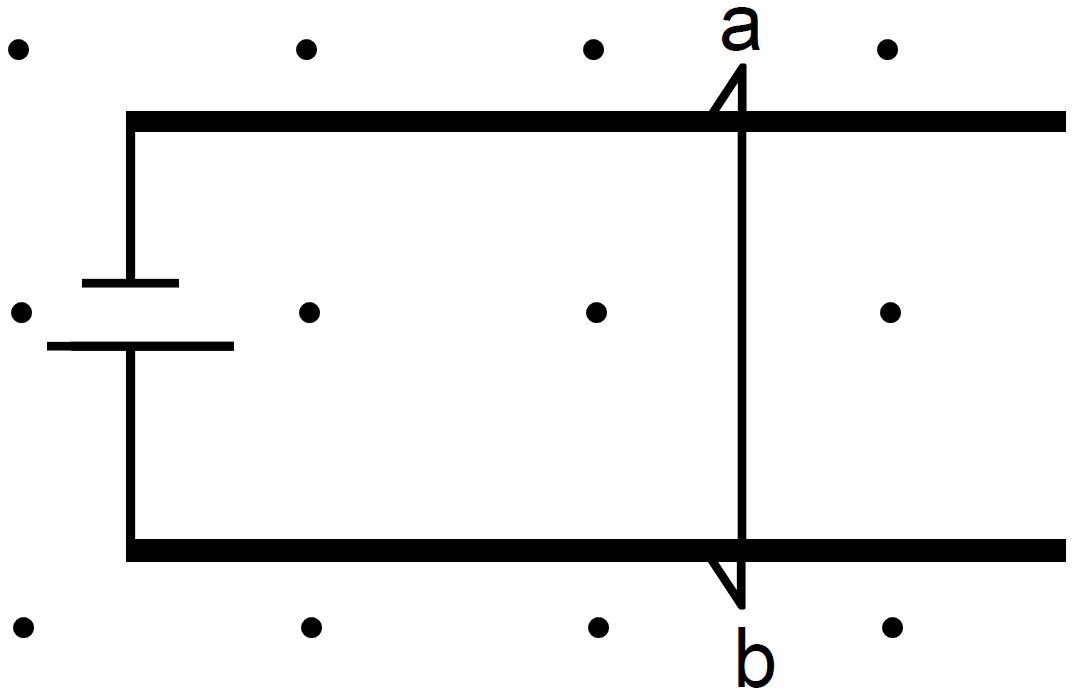
Figure shows a smooth pair of thick metallic rails connected across a battery of emf $\in$ having a negligible internal resistance. A wire ab of length l and resistance r can slide smoothly on the rails. The entire system lies in a horizontal plane and is immersed in a uniform vertical magnetic field B. At an instant t, the wire is given a small velocity u towards right.
  1. Find the current in it at this instant. What is the direction of the current?
  2. What is the force acting on the wire at this instant?
  3. Show that after some time the wire ab will slide with a constant velocity. Find this velocity.

A string of length L fixed at both ends vibrates in its fundamental mode at a frequency v and a maximum amplitude A.
  1. Find the wavelength and the wave number k.
  2. Take the origin at one end of the string and the X-axis along the string. Take the Y-axis along the direction of the displacement. Take t = 0 at the instant when the middle point of the string passes through its mean position and is going towards the positive y-directian. Write the equation describing the standing wave:
The momentum p of a particle changes with time t according to the relation $\frac{\text{dp}}{\text{dt}}=(10\text{N})+(2\text{N/s)t}.$ If the momentum is zero at t = 0, what will the momentum be at t = 10s?
A beam of light moving along $x$-axis is represented by the electric field $E_y=600 Vm ^{-1} \sin \omega$ $\left(t-\frac{x}{c}\right)$. Calculate the maximum magnitudes of electric and magnetic fields on a charge $q=2 e$ moving along the $y$-axis with a speed of $3.0 \times 10^7 m / s$ (where $\left.e=1.6 \times 10^{-19} C \right)$.
A homogeneous poorly conducting medium of resistivity fills up the space between two thin coaxial ideally conducting cylinders. The radii of the cylinders are equal to a and b with a < b, the length of each cylinder is l. Neglecting the edge effects, find the resistance of the medium between the cylinders.
What is Rydberg constant ? Write down its unit.