Question
What is nucleus? Give a general introduction.

Answer

The central part of an atom is called nucleus. The nucleus contains the positive charge of the atom and mass densely concentrated at the centre of the atom.
The dimensions of a nucleus are much smaller than those of an atom.
Rutherford's experiments on scattering of $\alpha$ particles demonstrated that the radius of a nucleus was smaller than the radius of an atom by a factor of about $10^4$.
From this we can say that the volume of a nucleus is about $10^{-12}$ times the volume of the atom.
In other words the atom is almost empty.
If an atom is enlarged to the size of a classroom, the nucleus would be of the size of pinhead.
The nucleus contains most (more than $99.9 \%$ ) of the mass of an atom.

Need a full question paper?

Generate a complete, print-ready paper with questions like this in minutes — across 16+ boards, with answer keys.
Start Generating Free

Similar questions

You are given ‘n’ resistors, each of resistance 'r'. These are first connected to get minimum possible resistance. In the second case, these are again connected differently to get maximum possible resistance. Compute the ratio between the minimum and maximum values of resistance so obtained.
Define the term ‘Half-life’ of a radioactive substance. Two different radioactive substances have half-lives T1 and T2 and number of undecayed atoms at an instant, N1 and N2, respectively. Find the ratio of their activities at that instant.
Two capacitors of capacitance $3 \mu F$ and 4 $\mu F$ are charged separately from a 6 V battery. When the battery is removed, they get connected to each other. In which the negative plate of one capacitor is connected to the positive plate of the other. Calculate the total final energy.
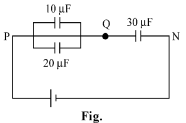
Find the equivalence between points $P$ and N of the combination shown in the figure.
Image
The speed of the yellow light in a certain liquid is 2.4 × 10⁸m/s. Find the refractive index of the liquid.
57Co decays to 57Fe by $\beta^+-\text{ emission.}$- emission. The resulting 57Fe is in its excited state and comes to the ground state by emitting $\gamma-\text{rays}.$ The half-life of $\beta^+-\text{decay}$ is 270 days and that of the $\gamma-\text{emissions}$ is 10-8 s. A sample of 57Co gives 5.0 × 10⁹ gamma rays per second. How much time will elapse before the emission rate of gamma rays drops to 2.5 × 10⁹per second?
Explain conductors and insulators with example. (This question can also be asked as difference between conductors and insulators.)
Using the equation $\overrightarrow{ B }=\mu_0(\overrightarrow{ H }+\overrightarrow{ M })$, Derive the equation $\overrightarrow{ B }=\mu \overrightarrow{ H }$ in case of a long solenoid carrying current I and having its interior filled with magnetic material.
Calculate the orbital period of the electron in the first excited state of hydrogen atom.
Two transparent slabs having equal thickness but different refractive indices $\mu_1$ and $\mu_2$ are pasted side by side to form a composite slab. This slab is placed just after the double slit in a Young's experiment so that the light from one slit goes through one material and the light from the other slit goes through the other material. What should be the minimum thickness of the slab so that there is a minimum at the point P0 which is equidistant from the slits?