Question
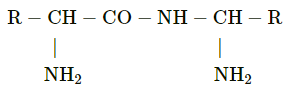
What is peptide linkage? How is tripeptide formed?

Need a full question paper?

Generate a complete, print-ready paper with questions like this in minutes — across 16+ boards, with answer keys.

Start Generating Free

Similar questions

Define and explain osmosis.
Why do the cell potential of lead accumulators decrease when it generates electricity ? How the cell potential can be increased ?
What is hydration of alkenes or olefins? How is it carried out? Explain with an example.###How are alcohols prepared from alkenes?
Calculate $\Delta S_{\text {surr }}$ when on mole of methanol $\left( CH _3 OH \right)$ is formed from its elements under standard conditions if $\Delta_{ f } H ^0\left( CH _2 OH \right)=-238.9 J mol ^{-1}$.
What is the value of $\Delta$ Ssurr for the following reaction at $298 K$ -
$6 CO _{2( g )}+6 H _2 O _{( l )} \rightarrow C _6 H _{12} O _{6( s )}+6 O _{2( g )}$
Given that: $\Delta G^{\circ}=2879 KJ mol ^{-1}$
$\Delta S^0=-210 J K ^{-1} mol ^{-1}$
What are the characteristics of rate constant?
In the reaction, $PCl _{5( g )} \rightarrow PCl _{3( g )}+ Cl _{2( g )}$, at a particular moment, the rate of disappearance of $PCl _5$ is $0.015 Ms ^{-1}$. What are the rates of formation of $PCl _3$ and $Cl _2$ ?
Determine whether the reactions with the following $\Delta H$ and $\Delta S$ values are spontaneous or nonspontaneous. State whether they are exothermic or endothermic.
(a) $\Delta H =-110 kJ$ and $\Delta S =+40 JK ^{-1}$ at $400 K$
(b) $\Delta H =+50 kJ$ and $\Delta S =-130 JK ^{-1}$ at $250 K$.
The density of silver having atomic mass $107.8 gram mol ^{-1}$ is $10.8 gram cm ^{-3}$. If the edge length of cubic unit cell is $4.05 \times 10^{-8} cm$, find the number of silver atoms in the unit cell. $\left( N _A=\right.$ $\left.6.022 \times 10^{23}, 1 \mathring A=10^{-8} cm \right)$
Identify A and B in the following reactions

Image

