Question
What is point electric charge?

Answer

►If the sizes of the charged objects are very small compared to the distance between them, they are called point charges.
►For such an object, their entire charge is assumed to be concentrated at a point in the space.

Need a full question paper?

Generate a complete, print-ready paper with questions like this in minutes — across 16+ boards, with answer keys.
Start Generating Free

Similar questions

If the solenoid in Exercise 5.5 is free to turn about the vertical direction and a uniform horizontal magnetic field of 0.25 T is applied, what is the magnitude of torque on the solenoid when its axis makes an angle of 30° with the direction of applied field?
The dielectric strength of air is 3.0 × 10⁶V/m. A parallel-plate air-capacitor has area 20cm2 and plate separation 0.10mm. Find the maximum rms voltage of an AC source that can be safely connected to this capacitor.
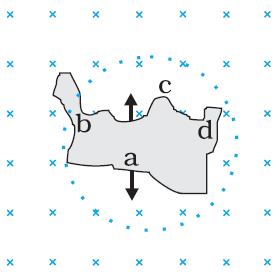
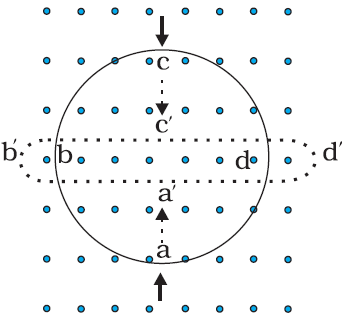
Use Lenz’s law to determine the direction of induced current in the situations described by Fig.
  1. A wire of irregular shape turning into a circular shape;

  1. A circular loop being deformed into a narrow straight wire.
​​​​​​​
Using the formula $\overrightarrow{\text{F}}=\text{q}\overrightarrow{\text{v}}\times\overrightarrow{\text{B}}$ and $\text{B}=\frac{\mu_0\text{i}}{2\pi\text{r}},$ show that the SI units of the magnetic field B and the permeability constant $\mu_0$ may be written as N/A-m and NA2 respectively.
Derive/obtain the equation of current in case of AC voltage applied to a resistor and also draw the graph showing the phase difference between voltage and current.
  1. Can two equipotential surfaces intersect each other? Give reasons.
  2. Two charges – q and +q are located at points A (0, 0, –a) and B (0, 0, +a) respectively. How much work is done in moving a test charge from point P (7, 0, 0) to Q (-3, 0, 0)?
Draw the graph of variation in potential difference and electric field with distance ' $r$ ' for a point electric charge $Q$.
In an electrolyte, the positive ions move from left to right and the negative ions from right to left. Is there a net current? If yes, in what direction?
An atom absorbs a photon of wavelength 500nm and emits another photon of wavelength 700nm. Find the net energy absorbed by the atom in the process.
The force on a north pole,$\overrightarrow{\text{F}}=\text{m}\overrightarrow{\text{B}},$ is parallel to the field $\overrightarrow{\text{B}}.$ Does it contradict our earlier knowledge that a magnetic field can exert forces only perpendicular to itself?