Question
What is Remote Sensing ? Mention two of its applications.

Answer

Remote Sensing : It can be defined as obtaining information about an object by observing it from a distance and without coming to actual contact with it.
Infact when we see an object and understand what it is, our eye is sensing that object remotely. This is a broad definition. But we generally use this terms for observing the surface of earth from space using satellites.
The most useful of remote sensing technology is that it makes possible the repetitive surveys of west areas in a very short time, even if the areas are inaccessible.
Space-based remote sensing is a new technology. It has high potential for applications in nearly all aspects of resource management.
Applications :
(i) In Forestry : Remote sensing helps in providing information about the extent of forest cover. It also gives a general idea of the types of forest cover. It also helps in the detection of forest hazards like fire, disease and excessive felling. It also helps in biomass and fuel-wood assessments.
(ii) In Land use mapping : Remote sensing data can be used to great advantage in up-to-date land use pattern of large areas at any given time. The changes that occur from time to time can also be monitored.
Need a full question paper?

Generate a complete, print-ready paper with questions like this in minutes — across 16+ boards, with answer keys.

Start Generating Free

Similar questions

The potential difference between the terminals of a battery of emf 6.0V and internal resistance $1\Omega$ drops to 5.8V when connected across an external resistor. Find the resistance of the external resistor.
In accordance with the Bohr's model, find the quantum that characterises the earth's revolution around the sun in an orbit of radius $1.5 \times 10^{11} m$ with orbital speed $3 \times 10^4 m / s$. (Mass of earth $=6.0 \times 10^{24} kg$. )
Define polarization.
(a) Identify the part of the electromagnetic spectrum used in (i) radar and (ii) eye surgery. Write their frequency range.
(b) Prove that the average energy density of the oscillating electric field is equal to that of the oscillating magnetic field.
Explain : Bar magnet as an equivalent solenoid.
A beam of monochromatic radiation is incident on a photosensitive surface. Answer the following questions giving reasons.
i. Do the emitted photoelectrons have the same kinetic energy?
ii. Does the kinetic energy of the emitted electrons depend on the intensity of incident radiation?
iii. On what factors does the number of emitted photoelectrons depend?
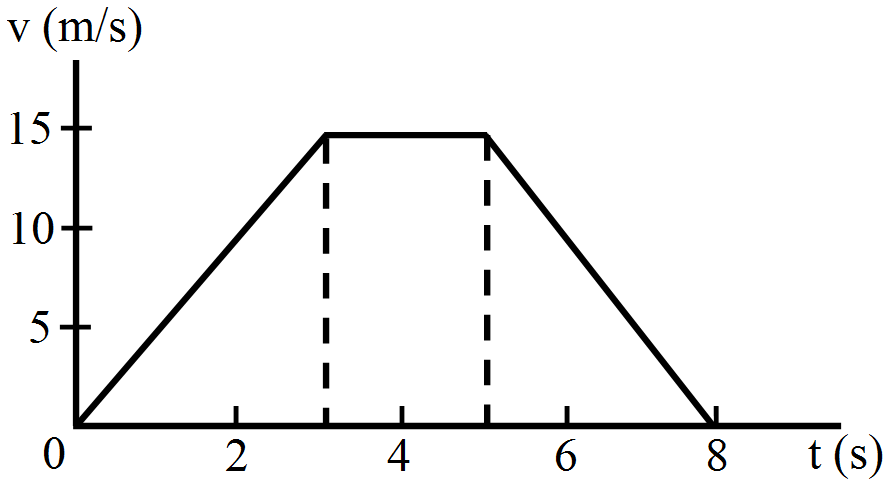
A particle of mass 50g moves on a straight line. The variation of speed with time is shown in figure. Find the force acting on the particle at t = 2, 4 and 6 seconds.

Define the electric resistivity of a conductor.
Plot a graph showing the variation of resistivity with temperature in the case of a (a) conductor, (b) semiconductor.
Briefly, explain, how the difference in the behaviour of the two can be explained in terms of number density of charge carriers and relaxation time.
A bar magnet of magnetic moment 6J/T is aligned at 60° with a uniform external magnetic field of 0·44T. Calculate (a) the work done in turning the magnet to align its magnetic moment (i) normal to the magnetic field, (ii) opposite to the magnetic field, and (b) the torque on the magnet in the final orientation in case (ii).
How is the mutual inductance of a pair of coils affected when:
i. separation between the coils is increased?
ii. the number of turns of each coil is increased?
iii. A thin iron sheet is placed between the two coils, other factors remaining the same?