Question
What is sludge? Explain how it is treated.

Answer

Semi-solids such as feaces that settle down during wastewater treatment are called sludge. This sludge is removed using a scraper and then transferred to a tank where it is decomposed by anaerobic bacteria to produce biogas. This biogas is used as a low cost fuel for heating, cooking, etc. It is also used to produce electricity.

Need a full question paper?

Generate a complete, print-ready paper with questions like this in minutes — across 16+ boards, with answer keys.
Start Generating Free

Similar questions

Which of the following are acidic and which are basic?
Lime water, Vinegar, Toothpaste, Stomach juices, Lemon juice, Baking soda solution, Milk of magnesia, Ammonia solution.
The average age of children of class VII is 12 years and 3 months. Express his age in second.
A small amount of hydrochloric acid is always produced in the stomach. Is it useful or harmful for us? If excess of acid is produced in the stomach, what should we do?
Explain the following.
  1. Copper and aluminium wires are usually employed for electricity transmission. Explain the reason.
  2. Explain how does the resistance of a wire vary with its length.
  3. The tungsten is used almost exclusively for filament of electric lamp. Comment.
One day Rahul’s mother after taking meal felt pain and irritation in her stomach. His father was out of station. Rahul was an intelligent boy. He remembered his teacher’s statement and gave his mother some baking soda solution Which gave her a relief from pain and irritation of stomach. Read the above passage and answer the following Questions.
  1. Which information given by Rahul’s teacher that helped him to select the baking soda as remedy?
  2. Why he selects baking soda as a cure?
  3. What values are shown by Rahul?
Complete the paragraph related to the life history of silk moth. by filling in the blanks: The _____$(a)$______ silk moth lays _____$(b)$____, from which hatch ____$(c)$____ called _____$(d)$____ or ____$(e)$____. They grow in size and when the caterpillar is ready to enter the next stage of its life history called _____$(f)$____, it first weaves a covering to hold itself, which is known as ____$(g)$_____.
Differentiate between transparent, translucent and opaque materials with one example each.
Draw a labelled diagram showing the process of photosynthesis.
Read the passage and answer the questions :
Seema builds a periscope using plane mirrors and observes people behind a wall.
Q.1. The periscope works on the principle of:
(a) Refraction$\quad$(b) Reflection
(c) Dispersion$\quad$(d) Diffraction
Q.2. The number of mirrors required in a simple periscope is:
(a) 1$\quad$$\quad$(b) 2
(c) 3$\quad$$\quad$(d) 4
Q.3. Which angle do the mirrors make in a periscope?
(a) $45^{\circ}$$\quad$(b) $60^{\circ}$
(c) $90^{\circ}$$\quad$(d) $180^{\circ}$
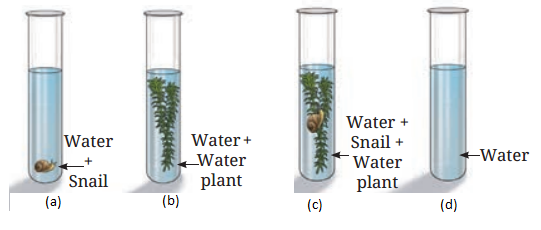
Ananya took four test tubes and filled three- fourth of each test tube with water. She labelled them A, B, C, and D (Fig). In test tube A, she kept a snail; in test tube B, she kept a water plant; in test tube C, she kept both a snail and a plant. In test tube D, she kept only water. Ananya added a carbon dioxide indicator to all the test tubes. She recorded the initial colour of water and observed if there are any colour changes in the test tubes after 2-3 hours. What do you think she wants to find out? How will she know if she is correct?
Image
Fig. Experimental set-up