Soil Profile: The vertical section of the soil showing the various layers from the surface to the unaffected parent material is known as a soil profile. The various layers are known as horizons. A soil profile contains three main horizons. They are named as horizon A, horizon B and horizon C.
Soil profile is the key for the soil classification and also forms the basis for the practical utility of soils. A mineral soil profile will include O, A, B, C and R master horizons and all the possible sub-horizons. Master horizons and sub horizons O horizon- It is called as organic horizon. It is formed in the upper part of the mineral soil, dominated by fresh or partly decomposed organic materials. This horizon contains more than 30% organic matter if mineral fraction has more than 50% clay (or) more than 20% organic matter if mineral fraction has less clay. The organic horizons are commonly seen in forest areas and generally absent in grassland, cultivated soils. 01- Ogranic horizon in which the original forms of the plant and animal residues can be recognized through naked eye. 02 Organic horizon in which the original plant or animal matter can not be recognized through naked eye.
A horizon : Horizon of organic matter accumulation adjacent to surface and that has lost clay, iron and aluminium.
A1 sub - horizon : Topmost mineral horizon formed adjacent to the surface. There will be accumulation of humified organic matter associated with mineral fraction and darker in colour than that of lower horizons due to organic matter.
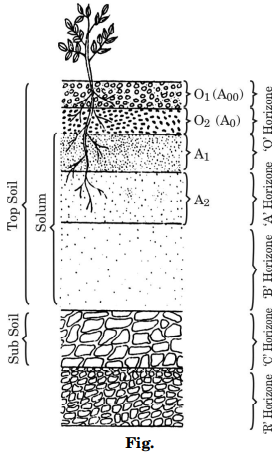 A2 sub - horizon :
 Horizon of maximum eluviation of clay, iron and aluminium oxides and organic matter. Loss of these constituents generally result in accumu-lation of quartz and other sand and silt size resistant minerals. Generally lighter in colour that horizons above and below.
A3 sub-horizon : A transitional layer between A and B horizons with more dominated properties of A1 or A2 above that the underlying B horizon. This horizon is sometimes absent.
B horizon : Horizon in which the dominant features are accumulation of clay, iron, aluminium or humus alone or in combination. Coating of sesquioxides will impart darker, stronger of red colour than overlying or underlying horizons.
B1 sub - horizon : A transitional layer between A and B. More like A than B.
B2 sub - horizon : Zone of maximum accumulation of clay, iron and aluminium oxide that may have moved down from upper horizons or may have formed in situ. The organic matter content is generally higher and colour darker than that of A2 horizon above.
B3 sub - horizon : Transitional horizon between B and C and with properties more similar to that of overlying B2 than underlying C.
C horizon : It is the horizon below the solum (A + B), relatively less affected by soil forming processes. It is outside the zone of major biological activity. It may contain accumulation of carbonates or sulphates, calcium and magnesium.
D or R horizon : Underlying consolidated bed rock and it may or may not be like the parent rock from which the solum is formed.
