Question
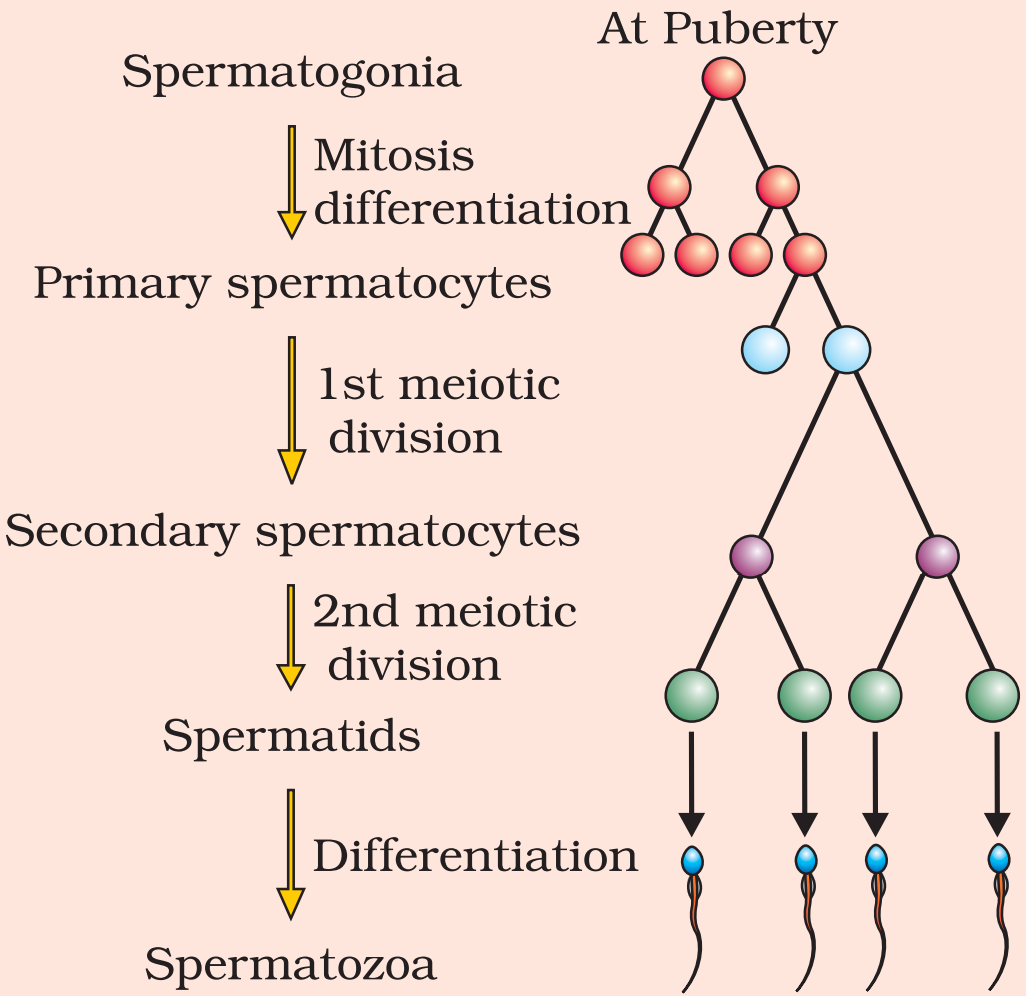
What is spermatogenesis? Briefly describe the process of spermatogenesis.

Answer

The process of the production of sperms from the immature germ cells in males is called spermatogenesis. The male germ cell of seminiferous tubules multiply mitotically to increase in numbers. Each spermatogonium is diploid and contains 46 chromosomes. Some of the spermatogonia called primary spermatocytes periodically undergo meiosis. A primary spermatocyte completes the first meiotic division (reduction division) leading to formation of two equal, haploid cells called secondary spermatocytes, which have only 23 chromosomes each. The secondary spermatocytes undergo the second meiotic division to produce four equal, haploid spermatids. The spermatids are transformed into spermatozoa (sperms) by the process called spermiogenesis.

Need a full question paper?

Generate a complete, print-ready paper with questions like this in minutes — across 16+ boards, with answer keys.

Start Generating Free

Similar questions

What are the basic characteristics of a modern landfil site. List any three and also mention the reasons for their use.
Describe the change that occur in ovaries and uterus in human female during the reproductive cycle.
Differentiate between microsporogenesis and megasporogenesis. Which type of cell division occurs during these events? Name the structures formed at the end of these two events.
State the Mendel’s law of inheritance that is universally acceptable.
Discuss the role of lymphoids in the immune response. Explain the different types of lymphoid organs giving two examples of each type in human.
What is genetic code? Write their four characteristics and draw a diagram of t-RNA.
Mention three applications and future challenges of human genome project.
Rose plants produce large, attractive bisexual flowers but they seldom produce fruits. On the other hand a tomato plant produces plenty of fruits though they have small flowers. Analyse the reasons for failure of fruit formation in rose.
Both these plants - rose and tomato - both selected by human beings for different characteristics, the rose for its flower and tomato for its fruit. Roses, being vegetatively propagated do not need to produce seeds.
What is meant by the term bio-pesticide? Name and explain the mode of action of a popular bio-pesticide.
Observe the representation of genes involved in the lac operon given below:
  1. Identify the region where the repressor protein will attach normally.
  2. Under certain conditions repressor is unable to attach at this site. Explain.
  3. If repressor fails to attach to the said site what products will be formed by z, y and a?
  4. Analyse why this kind of regulation is called negative regulation.
