Question
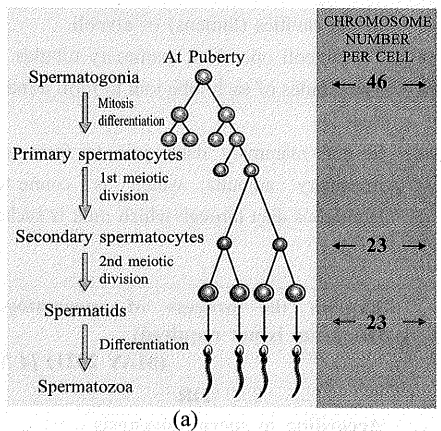
What is spermatogenesis? Briefly describe the process of spermatogenesis.###Explain the process of spermatogenesis. (Diagram is not required)###According to spermatogenesis (i) Development of sperm from primary spermatocytes. Explain it. (ii) Role of hormones which secreting from pituitary gland (iii) Structure of sperm (Diagram is not necessary)

Need a full question paper?

Generate a complete, print-ready paper with questions like this in minutes — across 16+ boards, with answer keys.

Start Generating Free

Similar questions

Describe Sex Determination in honey bee with diagram.
Read the following and answer any four questions from (i) to (v) given below:

Rajesh, Ravi, and Rohit are roommates. 'They are doing their graduation. Few months back Ravi fell ill. it took him around 3 weeks to recover. Both his friends were absolutely healthy at that time. After sometime, Rajesh also fell ill from some other disease. This time Ravi and Rohit both contracted the same illness. Based on the above information, answer the following questions.

  1. Which of the following holds true for Ravi's illness?
  1. Ravi was suffering from a communicable disease that is transmitted through vector.
  2. Ravi was suffering from a communicable disease that is transmitted through faecal oral route.
  3. Ravi was suffering from a non-communicable disease like anaemia.
  4. Ravi was suffering from a non-communicable disease like Down's syndrome.
  1. Select the correct statement.
  1. Ravi contracted a disease caused by air borne microbes.
  2. Ravi could have suffered a nutritional disorder.
  3. Ravi suffered a non-contagious disease.
  4. Both (b) and (c)
  1. Which could be correctly said for Rajesh's illness?
  1. Rajesh's illness was due to a microbial infection.
  2. Rajesh's illness could be contagious or non-contagious.
  3. Rajesh's illness could be cured by antibiotics.
  4. All of these
  1. Which of the following may depicts Ravi's and Rajesh's illness?
S.no
Ravi
Rajesh
(a)
Which of the following may depicts Ravi's and Rajesh's illness?
Myocardial infection
(b)
Whooping cough
Tetanus
(c)
Gastritis
Rhinitis
(d)
Hypertensio
Thyroid
  1. Assertion: Diabetes mellitus is a non-communicable disease which can be completely cured.

Reason: Diabetes mellitus is caused by deficiency of aldosterone hormone.

  1. Both assertion and reason are true, and reason is the correct explanation of assertion.
  2. Both assertion and reason are true, but reason is not the correct explanation of assertion.
  3. Assertion is true, but reason is false.
  4. Both assertion and reason are false.
Read the following and answer any four questions from (i) to (v) given below:

A woman unable to conceive after many years of regular unprotected coitus went to specialised infertility clinic. On complete examination, woman was found to be normal, while male partner was diagnosed with infertility. Male partner is unable to copulate the female. Couple was advised to opt for assisted reproductive technology (ART).

  1. Which ART could have been useful for this couple?
  1. ZIFT
  2. IUT
  3. AI
  4. GIFT
  1. In which of the following infertility issues could this technique be used?
  1. Anovulation.
  2. Oligospermia.
  3. Low fructose content in seminal fluid.
  4. All of these.
  1. Which among the following techniques is useful to conceive when there is very low sperm count?
  1. GIFT
  2. Test-tube baby
  3. IUT
  4. JCSI
  1. Assertion: Artificial insemination (AI) is intra-uterine insemination.

Reason: In Al, sperms collected from donor are introduced into the uterus.

  1. Both assertion and reason are true, and reason is the correct explanation of assertion.
  2. Both assertion and reason are true, but reason is not the correct explanation of assertion.
  3.  Assertion is true, but reason is false.
  4. Both assertion and reason are false
  1. Success rate of artificial insemination technique is:
  1. 20-40%
  2. 60-70%
  3. 40-50%
  4. 5-7%
Read the following and answer any four questions from (i) to (v) given below:

A young couple married for 5 years is unable to bear a child in spite of not practicing any birth control method. Upon consultation, doctor advised them an assisted reproductive technology involving transfer of gametes into oviducts.

  1. Identify the technique adopted by the couple.
  1. ZIFT
  2. JUI
  3. GIFT
  4. ICSI
  1. What is the pre-requisite of this technique?
  1. Gamete formation should be normal.
  2. Fallopian tubes should be normal.
  3. Female should have thick endometrial lining.
  4. Male should be able to copulate the female.
  1. Assertion: GIFT is an in-vitro fertilisation technique.

Reason: In GIFT, gametes are fertilised outside the female body.

  1. Both assertion and reason are true, and reason is the correct explanation of assertion.
  2. Both assertion and reason are true, but reason is not the correct explanation of assertion.
  3. Assertion is true, but reason is false.
  4. Both assertion and reason are false.
  1. The procedure advised to couple involves the transfer of:
  1. Fertilised ovum.
  2. Embryo with 8 blastomeres.
  3. Sperms and unfertilised ovum.
  4. Embryo with 16 blastomeres.
  1. What is the success rate of this procedure?
  1. 30-50%
  2. < 20%
  3. 80-85%
  4. 27-30%
Read the following text carefully and answer the questions that follow:
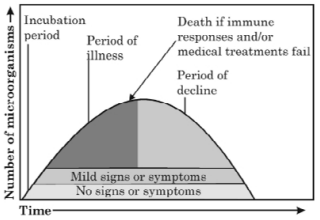
When a microorganism invades a host, a definite sequence of events usually occur leading to infection and disease, causing suffering to the host. This process is called pathogenesis. Once a microorganism overcomes the defense system of the host, development of the disease follows a certain sequence of events as shown in the graph. Study the graph given below for the sequence of events leading to appearance of a disease and answer the questions that follow:
Image
i. In which period, according to the graph there are maximum chances of a person transmitting a disease/infection and why? (1)
ii. Study the graph and write what is an incubation period. Name a sexually transmitted disease that can be easily transmitted during this period. Name the specific type of lymphocytes that are attacked by the pathogen of this disease. (1)
iii. Draw a schematic labelled diagram of an antibody. (2)
OR
In which period, the number of immune cells forming antibodies will be the highest in a person suffering from pneumonia?
Name the immune cells that produce antibodies. (2)
Read the following and answer any four questions from (i) to (v) given below:

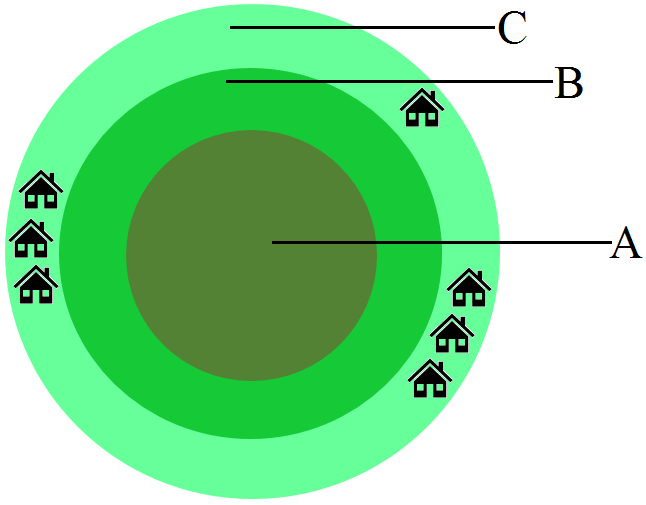
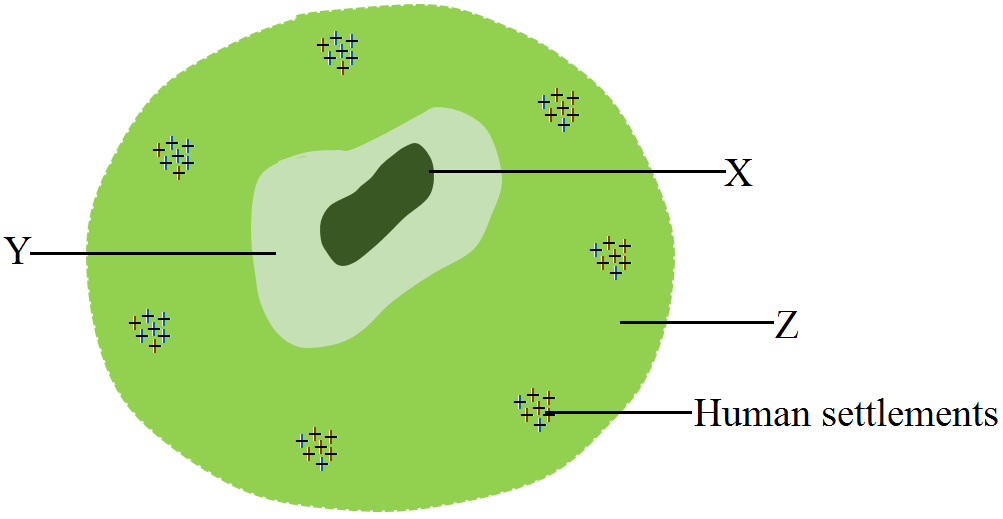
Biosphere reserves are multipurpose protected areas which are meant for preserving genetic diversity in representative ecosystems of various natural biomes and unique biological communities by protecting wild populations, traditional life style of tribals and domesticated plant/animal genetic resources. Each biosphere reserve has three zones-core, buffer and transition zone.

  1. Which of the following is similar to biosphere reserve in terms of conservation?
  1. Gene banks.
  2. Offsite collection.
  3. Orchards.
  4. Hotspots.
  1. Refer to the given figure representing different zones of a biosphere reserve and select the correct option regarding it.

  1. A-Limited human activity is allowed such as for research and education.
  2. B-An active co-operation occurs between reserve management and local people for activities like cropping, settlements, etc.
  3. C-No human activity is allowed.
  4. None of these.
  1. Refer to the given diagrammatic representation of a biosphere reserve.

Select the incorrect statement regarding X, Y and Z.

  1. X is devoted to strict protection of wildlife and no human activity is allowed in this zone.
  2. In Y, only limited human activity (compatible with conservation) is allowed.
  3. In Z, commercial exploitation of natural resources is allowed.
  4. Tourism is allowed in Z zone only.
  5. Zone Y helps to maintain the lifestyle of the tribal people living in the area.
  1. (iii), (iv) and (v) only
  2. (ii), (iii) and (v) only
  3. (i), (iii) and (iv) only
  4. (ii), (iii) and (iv) only
  1. Biosphere reserves differ from national parks and wildlife sanctuaries because in the former.
  1. Human beings are not allowed to enter
  2. People are an integral part of the system
  3. Plants are paid greater attention than the animals
  4. Living organisms are brought from all over the world and preserved for posterity.
  1. MAB Programme means.
  1. Man and biosphere programme.
  2. Man and biodiversity conservation programme.
  3. Manually aided biosphere conservation programme.
  4. None of these.
Read the following and answer any four questions from S(i) to S(v) given below:

Rajat is a student of biotechnology. His professor tells him that for transformation with recombinant DNA the bacterial cells must be made capable of taking up DNA as DNA do not pass through membrane. While doing experiment in the lab, Rajat noticed that bacterial cells were not taking up the foreign DNA even after treating it with sodium ion. He asked his professor, the reason behind this. His professor explained that he should check the valency and charge of the ion that he is using for the treatment.

  1. It is difficult for DNA to pass through the membrane as
  1. It is a hydrophilic molecule.
  2. It is a hydrophobic molecule.
  3. It is a circular molecule.
  4. It changes its shape when it comes in contact with host cell.
  1. What type of ions are used for DNA mediated gene transfers?
  1. Divalent anions.
  2. Divalent cations.
  3. Monovalent cations.
  4. Monovalent anions.
  1. rDNA stands for,
  1. reduced DNA
  2. red DNA
  3. recombinant DNA
  4. related DNA.
  1. Which of the following statements with regard to DNA is correct?
  1. DNA is a positively charged molecule having two polynucleotide chains.
  2. Nitrogen bases of two polynucleotide chain form complementary pairs, i.e., A opposite G and T opposite C.
  3. Backbone of DNA chain is built up of alternate deoxyribose sugar and phosphate group.
  4. Both (a) and (c)
  1. Assertion: Competent host is essential for transformation with rDNA.

Reason: Transfer of DNA in a prokaryotic cell is called transfection.

  1. Both assertion and reason are true and reason is the correct explanation of assertion.
  2. Both assertion and reason are true but reason is not the correct explanation of assertion.
  3. Assertion is true but reason is false.
  4. Both assertion and reason are false.
Read the following and answer any four questions from (i) to (v) given below:

Siddharth is a chain smoker. He got into this habit in early adolescence due to peer pressure and gradually got addicted to this habit. Its now almost 20 years he is into the habit of smoking. Since few months he is experiencing pain in chest, shortness of breath, wheezing and chronic cough with phlegm. He seeked advice of a medical practitioner who diagnosed him with lung cancer. Based on the above information, answer the following questions.

  1. What do you think is the possible carcinogen responsible for Siddharth's lung cancer?
  1. Nitrosamines
  2. Benzo(a)pyrene
  3. Hydrazine
  4. All of these
  1. How is lung cancer diagnosed?
  1. Computerised tomography scan
  2. Sputum cytolog
  3. Biopsy of lung tissue
  4. All of these
  1. From which of the following type of cancer is Siddharth suffering from?
  1. Sarcoma
  2. Carcinoma
  3. Lymphoma
  4. Leukemia
  1. Select the correct statement.
  1. Surgery, radiotherapy and chemotherapy can be used to treat lung cancer.
  2. Chemotherapy involves the exposure of cancerous parts to X rays which destroy rapidly growing cancer cells.
  3. Surgical removal of lung cancer tissue is suggested at advanced stage 4.
  4. Monoclonal antibodies can effectively treat lung cancer and can cure it completely.
  1. Assertion: Lung cancer if not treated at an early stage can spread to other initial organs of the body.

Reason: Cancer cell have uncontrolled proliferation and ability to invade new sites (metastasis).

  1. Both assertion and reason are true and reason is the correct explanation of assertion.
  2. Both assertion and reason are true but reason is not the correct explanation of assertion.
  3. Assertion is true but reason is false.
  4. Both assertion and reason are false
Define decomposition and describe the processes and products of decomposition.###Describe factor affecting decomposition.
Read the following and answer any four questions from (i) to (v) given below:

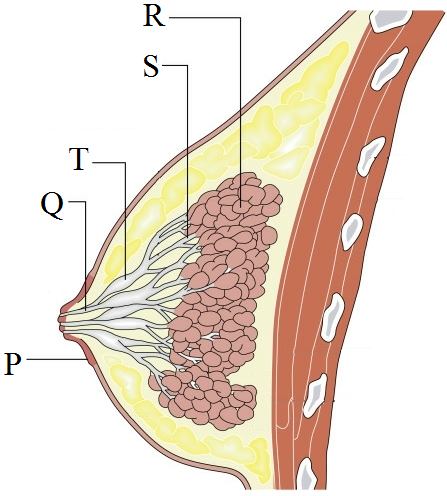
A functional mammary gland is characteristic of all female mammals. Mammary glands are paired structures that contain glandular tissue and variable amount of fat. Refer to the given figure of a mammary gland and answer the following questions.

  1. Mammary glands are modified:
  1. Sweat glands.
  2. Sebaceous glands.
  3. Sudoriferous glands.
  4. Lacrimal glands.
  1. Identify the incorrectly matched pair.
  1. P - Areola.
  2. Q - Lactiferous duct.
  3. S - Mammary duct.
  4. T - Mammary alveoli.
  1. Mammary ducts expand to form:
  1. Mammary alveoli.
  2. Mammary ampullae.
  3. Lactiferous ducts.
  4. Mammary tubules.
  1. What is areola?
  1. Grape-like clusters of milk secreting structures.
  2. Fatty tissue between the mammary lobes.
  3. Circular pigmented area of skin around nipple.
  4. Connective tissue that supports the alveoli and ducts.
  1. Assertion: The size of breast depends on the amount of adipose tissue.

Reason: The adipose tissue supports the alveoli and the ducts.

  1. Both assertion and reason are true, and reason is the correct explanation of assertion.
  2. Both assertion and reason are true, but reason is not the correct explanation of assertion.
  3. Assertion is true, but reason is false.
  4. Both assertion and reason are false.