Question
What is stereochemistry ? Explain plane polarised light, optical activity and optical isomers.

Answer

→ Stereochemistry is the branch of that involves "the study of the different spatial arrangements of atoms in molecules".
→ Plane polarised light (PPL) when ordinary light is passed through a nicol prism a light of single wavelength vibrating in a single plane is obtained this is known as plane polarised light.
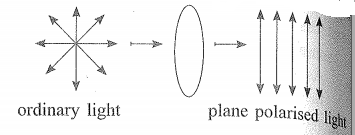
Image
→ Optical activity: "When plane polarised ligh is passed through a solution the light is rotated either in clockwise or in a anticlockwise direction by a certain angle. These types of compounds an known as optical active compound and such property is known as optical activity."
→ The angle by which the plane polarised light is rotated is measured by an instrument called polarimeter.
→ If the compound rotates the plane of plan polarised light to the right, i.e., clockwis direction, it is called dextrorotatory (Greek for right rotating) or the d-form and is indicated by placing a positive (+) sign before the degree of rotation.
→ If the light is rotated towards left (anticlockwis direction), the compound is said to be laevo rotatory or the l-form and a negative (-) sign in placed before the degree of rotation.
→ Such (+) and (-) isomers of a compound an called optical isomers and the phenomenon is termed as optical isomerism.

Need a full question paper?

Generate a complete, print-ready paper with questions like this in minutes — across 16+ boards, with answer keys.

Start Generating Free

Similar questions

$^{238}_{92}\text{U}$ Change to $^{206}_{92}\text{Pb}$ by successive radioactive decay.
A sample of urenium ore was anlaysed and found to contain $1.0\ g$ of $^{238}\text{U}$ and $0.1\ g$ of $^{206}\text{Pb}$ had accumulated due to decay of $^{238}\text{U}$, find out the age of ore. (Half- life of $^{238}\text{U}$$= 4.5\times10^9$ years).
  1. For the complex $[Fe(CO)_5],$ write the hybridization, magnetic character and spin of the complex. $($At. number : $Fe = 26)$
  2. Define crystal field splitting energy.
Explain the acidic nature of alcohols and phenols by their reaction with metals. $\#\#\# \ '$ Alcohols and phenols are acidic in nature' verify the truth of this statement by a reaction with metals.
Give reasons:
  1. $C–Cl$ bond length in chlorobenzene is shorter than $C–Cl$ bond length in $CH_3–Cl.$
  2. The dipole moment of chlorobenzene is lower than that of cyclohexyl chloride.
  3. $S_N1$ reactions are accompanied by racemization in optically active alkyl halides.
What is organo metallic compound? Explain grignard reagent.
Write the Nernst equation and emf of the following cells at 298 K : $\mathrm{Fe}(\mathrm{s})\left|\mathrm{Fe}^{2+}(0.001 \mathrm{M})\right|\left|\mathrm{H}^{+}(1 \mathrm{M})\right| \mathrm{H}_2(\mathrm{~g})(1$ bar $) \mid \mathrm{Pt}(\mathrm{s})$
If the radius of the octahedral void is r and radius of the atoms in closepacking is R, derive relation between r and R.
To what extent do the electronic configurations decide the stability of oxidation states in the first series of the transition elements? Illustrate your answer with examples.
Predict the order of reactivity of the following compounds in $S_N1$ and $S_N2$ reactions:
$C_6H_5CH_2Br, C_6H_5CH(C_6H_5)Br, C_6H_5CH(CH_3)Br, C_6H_5C(CH_3)(C_6H_5)Br.$
Write the structures of main products when benzene diazonium chloride reacts with the following reagents:
  1. $CuCN$
  2. $CH_3CH_2OH$
  3. $KI$