Question
What is stereochemistry ? Explain plane polarised light, optical activity and optical isomers.

Answer

→ Stereochemistry is the branch of that involves "the study of the different spatial arrangements of atoms in molecules".
→ Plane polarised light (PPL) when ordinary light is passed through a nicol prism a light of single wavelength vibrating in a single plane is obtained this is known as plane polarised light.
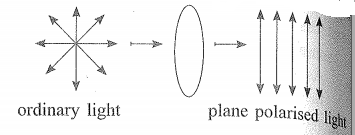
Image
→ Optical activity: "When plane polarised ligh is passed through a solution the light is rotated either in clockwise or in a anticlockwise direction by a certain angle. These types of compounds an known as optical active compound and such property is known as optical activity."
→ The angle by which the plane polarised light is rotated is measured by an instrument called polarimeter.
→ If the compound rotates the plane of plan polarised light to the right, i.e., clockwis direction, it is called dextrorotatory (Greek for right rotating) or the d-form and is indicated by placing a positive (+) sign before the degree of rotation.
→ If the light is rotated towards left (anticlockwis direction), the compound is said to be laevo rotatory or the l-form and a negative (-) sign in placed before the degree of rotation.
→ Such (+) and (-) isomers of a compound an called optical isomers and the phenomenon is termed as optical isomerism.

Need a full question paper?

Generate a complete, print-ready paper with questions like this in minutes — across 16+ boards, with answer keys.

Start Generating Free

Similar questions

Write the Nernst equation and emf of the following cells at $298\ K:$
$Pt(s) | Br_2(l) | Br^– (0.010 M) || H^+ (0.030 M) | H_2(g) (1\ bar)|Pt(s).$
$^{238}_{92}\text{U}$ Change to $^{206}_{92}\text{Pb}$ by successive radioactive decay. A sample of urenium ore was anlaysed and found to contain $1.0 g$ of $^{238}\text{U}$ and $0.1 g$ of $^{206}\text{Pb}$ had accumulated due to decay of $^{238}\text{U}$, find out the age of ore. $($Half$-$ life of $^{238}\text{U}$$= 4.5\times10^9$ years$).$
What happens when
  1. Ethyl chloride is treated with $\ce{NaI}$ in the presence of acetone,
  2. Chlorobenzene is treated with $\ce{Na}$ metal in the presence of dry ether,
  3. Methyl chloride is treated with $\ce{KNO_2}$?
Write chemical equations in support of your answer.
Write down the $\text{IUPAC}$ name for the following complex and indicate the oxidation state, electronic configuration and coordination number. Also give stereochemistry and magnetic moment of the complex:
$\ce{Cs[FeCl_4]}$
Complte the following reaction : $\ce{C_6H_5 COOH + SOCI_2 \rightarrow}$
Calculate $(a)$ molality $(b)$ molarity and $(c)$ mole fraction of $KI$ if the density of $20\% ($mass/mass$)$ aqueous $KI$ is $1.202\ g\ mL^{-1}.$
Calculate the charge of one mole of electrons.
After 24 hrs. Only 0.125gm out of the initial quantity of 1gm of a radioactive isotope remains behind. What is its half life period?
  1. Define crystal field splitting energy. On the basis of crystal field theory, write the electronic configuration for $d^4$ ion if $\triangle_0>\text{P}.$
  2. Write the hybridization and magnetic character of $\ce{[CoF_6]^{3–}}. ($At. no. of $Co = 27)$
Give the mechanism for the formation of ethanol from ethene.