Question
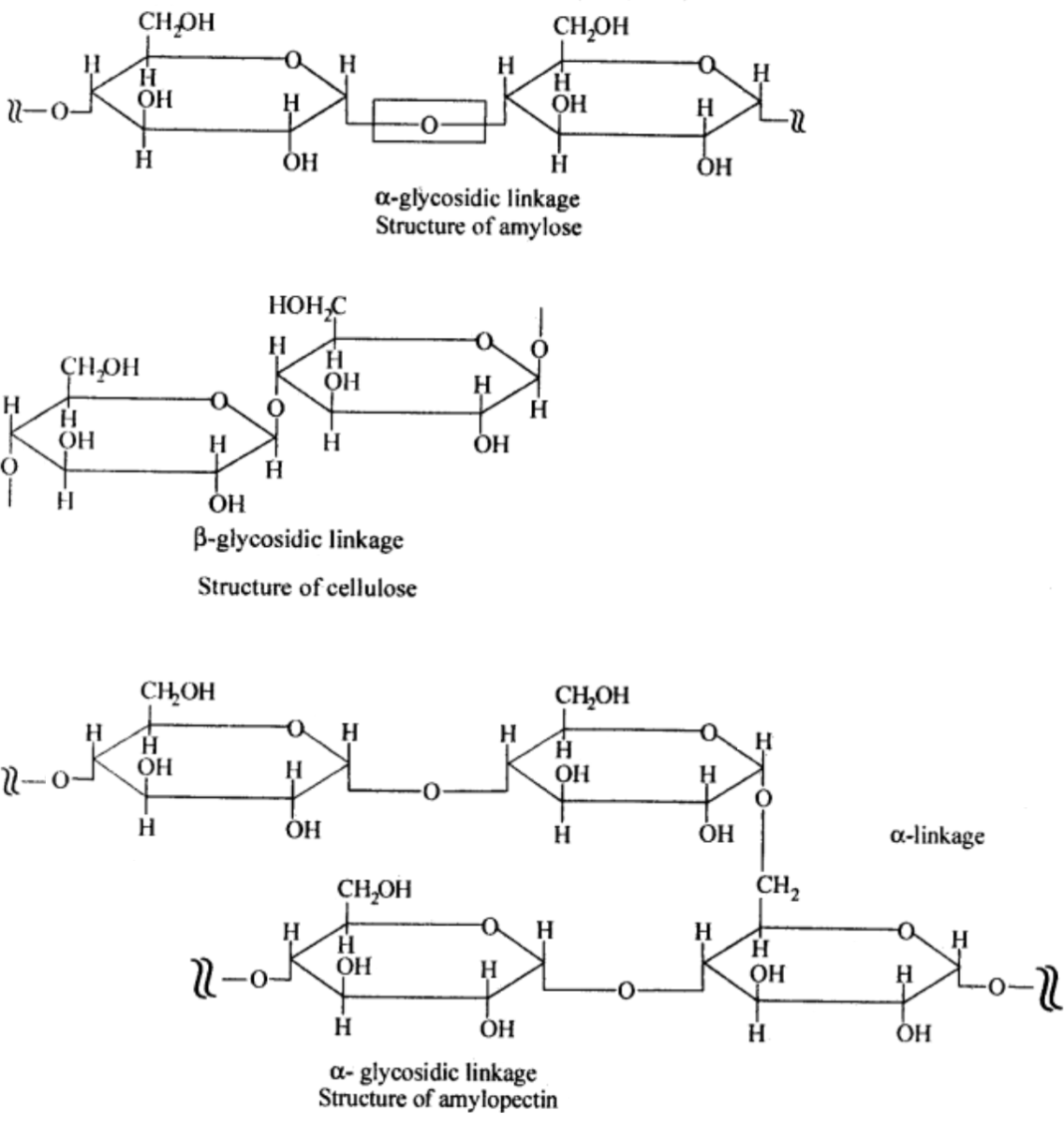
What is the basic structural difference between starch and cellulose?
Answer


Starch consists of amylase and amylopectin. Amylase is a linear polymer of  $\alpha-\text{D}-$ glucose while cellulose is a linear polymer of  $\beta-\text{D}-$ glucose. In amylase, C - 1 of one glucose unit is connected to C - 4 of the other through $\alpha-$glycosidic linkage. However in cellulose, C - 1 of one glucose unit is connected to C - 4 of the other through $\beta-$ glycosidic linkage. Amylopectin on the other hand has highly branched structure .

Need a full question paper?

Generate a complete, print-ready paper with questions like this in minutes — across 16+ boards, with answer keys.

Start Generating Free

Similar questions

Write the Nernst equation for the cell reaction in the Daniel cell. How will the $E_{Cell}$ be affected when concentration of $Zn^{2+}$ ions is increased?
Calculate the value of $\text{EMF}$ for the cell reaction :
$Cu_{(s)}+2 Ag_{(aq)}^{+} \rightarrow Cu_{(aq)}^{2+}+2 Ag_{(s)}$
$E_{Cu^{+2} / Cu}^{o}=0.34 V \text { and } E_{Ag^{+} / Ag}^{o}=0.80 V$
(i) Write the equation for the reaction of $CH _3 I$ with $KNO _2$ and $AgNO _2$.
(ii) Write the Friedel-Crafts reaction to prepare toluene from benzene.
Answer the following questions.
Give one structural difference between amylose and amylopectin.
Match the items of Column I and Column II.
 
Column I
 
Column II
(i)
Diamond.
(a)
Short interval of time.
(ii)
Instantaneous rate.
(b)
Ordinarily rate of conversion is imperceptible.
(iii)
Average rate.
(c)
Long duration of time.
What happens when $D -$ glucose is treated with the following reagents?
  1. $HI$
  2. Bromine water
  3. $\ce{HNO3}$
What happens when the vapours of a primary, secondary and tertiary alcohol are passed over heated copper at 573 K temperature? Explain with chemical equation.
Write note on Mercury cell (Zn-Hg)
Note: In the following questions a statement of assertion followed by a statement of reason is given. Choose the correct answer out of the following choices.
Assertion: $Λ_m$ for weak electrolytes shows a sharp increase when the electrolytic solution is diluted.
Reason: For weak electrolytes degree of dissociation increases with dilution of solution.
(i) Which is the simplest monocarboxylic acid exhibit optical isomerism and why?
(ii) What isomerism exhibited by propanoic acid and ethyl methanoate?