Question
What is the Bernoulli's principle for the horizontal tube?

Answer

Bernoulli's principle for horizontal tube :
$ \left(P_1-P_2\right)=\frac{1}{2} \rho\left(v_2^2-v_1^2\right) $

Need a full question paper?

Generate a complete, print-ready paper with questions like this in minutes — across 16+ boards, with answer keys.

Start Generating Free

Similar questions

Why are we not able to rotate a wheel by pulling or pushing along its radius?
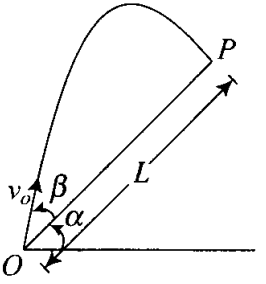
A particle is projected in air at an angle $\beta$ to a surface which itself is inclined at an angle $\alpha$ to the horizontal (Fig.).

  1. Find an expression of range on the plane surface (distance on the plane from the point of projection at which particle will hit the surface).
(Hint: This problem can be solved in two different ways:

  1. Point P at which particle hits the plane can be seen as intersection of its trajectory (parobola) and straight line. Remember particle is projected at an angle $(\alpha+\beta)$ w.r.t. horizontal.
  2. We can take x-direction along the plane and y-direction perpendicular to the plane. In that case resolve g (acceleration due to gravity) in two differrent components, gx along the plane and gy perpendicular to the plane. Now the problem can be solved as two independent motions in x and y directions respectively with time as a common parameter.)
Is it possible to put a satellite into its orbit by firing it from a huge sized gun?
Why do the asbestos roof of houses get lifted in hurricane?
If the speed of a rod moving at a relativistic speed parallel to its length is doubled,
  1. The length will become half of the original value.
  2. Mass will become double of the original value.
  3. The length will decrease.
  4. The mass will increase.
Which of these is largest : astronomical unit, light year and par sec?
Put a piece of chalk into water. The chalk will emit bubbles in all directions. Explain.
Why is the dam of water reservoir thick at the bottom?
A particle is in linear simple harmonic motion between two points, A and B, 10cm apart. Take the direction from A to B as the positive direction and give the signs of velocity, acceleration and force on the particle when it is:

At 3cm away from A going towards B.

The density of a rod AB continuously increases from A to B. Is it easier to set it in rotation by clamping it at A and applying a perpendicular force at B or by clamping it at B and applying the force at A?