Question
What is the coherent source?

Answer

Those two sources which emit waves of same frequency or same wavelength and the phase difference between them remains constant with time, are called coherent source.

Need a full question paper?

Generate a complete, print-ready paper with questions like this in minutes — across 16+ boards, with answer keys.
Start Generating Free

Similar questions

An electric bulb marked 220V, 100W will get fused if it is made to consume 150W or more. What voltage fluctuation will the bulb withstand?
The electric potential inside a charged spherical ball is given by $\phi=a r^2+b$. Where $r$ is the distance from the centre, $a$ and $b$ are constants. Calculate the charge density inside the ball.
A spherical shell is heated. The volume change according to the equation $\text{V}_\theta=\text{V}_\theta(1+\gamma\theta)$. Does the volume refer to the volume enclosed by the shell or the volume of the material making up the shell?
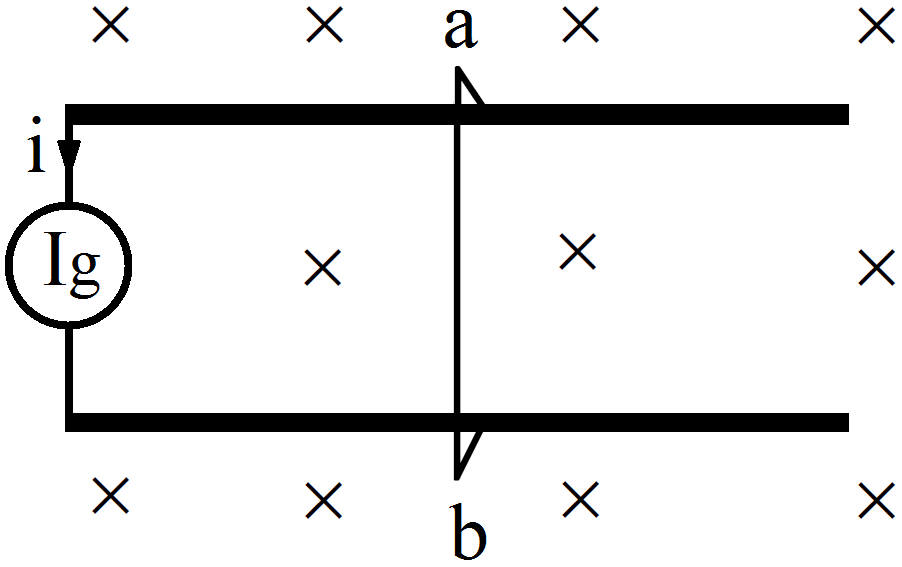
The current generator Ig shown in figure, sends a constant current i through the circuit. The wire ab has a length l and mass m and can slide on the smooth, horizontal rails connected to Ig. The entire system lies in a vertical magnetic field B. Find the velocity of the wire as a function of time.

An oil drop of 12 excess electrons is held stationary under a constant electric field of 2.55 × 10⁴ NC-1 in Millikan’s oil drop experiment. The density of the oil is 1.26 g cm-3. Estimate the radius of the drop. (g = 9.81 m s-2; e = 1.60 × 10⁻¹⁹ C).
Mention two specific characteristics of nuclear force.
Draw a ray diagram of a reflecting type telescope. State two advantages of this telescope over a refracting telescope.
Find the time required to liberate 1.0 litre of hydrogen at STP in an electrolytic cell by a current of 5.0A.
A heavy particle of mass m falls freely near the earth's surface. What is the torque acting on this particle about a point 50cm east to the line of motion? Does this torque produce any angular acceleration in the particle?
A disc rotates about its axis with a constant angular acceleration of 4rad/s2. Find the radial and tangential accelerations of a particle at a distance of 1cm from the axis at the end of the first second after the disc starts rotating.