MCQ
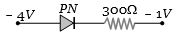
What is the current in the circuit shown below.....$amp$
  • $0$
  • B
    ${10^{ - 2}}$
  • C
    $1$
  • D
    $0.10 $

Answer

Correct option: A.
$0$
a
(a) The potential of $P-$side is more negative that of $N-$side, hence diode is in reverse biasing. In reverse biasing it acts as open circuit, hence no current flows.

Need a full question paper?

Generate a complete, print-ready paper with questions like this in minutes — across 16+ boards, with answer keys.

Start Generating Free

Similar questions

A wire of resistance $20 \Omega$ is divided into $10$ equal parts. A combination of two parts are connected in parallel and so on. Now resulting pairs of parallel combination are connected in series. The equivalent resistance of final combination is_______.0$\Omega$.
The electric field of an electromagnetic wave in free space is represented as $\vec{E}=E_0 \cos (\omega t-k z) \hat{i}$ The corresponding magnetic induction vector will be :
The motion of a particle along a straight line is described by equation $x = 8 + 12t - t^3$ where $x$ is in metre and $t$ in second. The retardation of the particle when its velocity becomes zero is...........$m/s^2$
The transconductance of a triode amplifier is $2.5 \,mili\, mho$ having plate resistance of $20 \, k \Omega$, amplification $10$. Find the load resistance........$ k \Omega$
The magnetic field of a plane electromagnetic wave is given by $\overrightarrow{ B }=3 \times 10^{-8} \cos \left(1.6 \times 10^3 x +48 \times 10^{10} t \right) \hat{ j }$, then the associated electric field will be :
A long solenoid has $500$ turns. When a current of $2$ $ampere$ is passed through it, the resulting magnetic flux linked with each turn of the solenoid is $4\,\times\,10^{-3}\,\,Wb$ . The self-inductance of the solenoid is .......$H$
A photon in motion has a mass
For an ideal heat engine, the temperature of the source is $127\,^{\circ} C$. In order to have $60\, \%$ efficiency the temperature of the sink should be $........\,{ }^{\circ} C$. (Round off to the Nearest Integer)
Two equally charged, identical metal spheres $A$ and $B$ repel each other with a force '$F$'. The spheres are kept fixed with a distance '$r$' between them. A third identical, but uncharged sphere $C$ is brought in contact with $A$ and then placed at the mid-point of the line joining $A$ and $B$. The magnitude of the net electric force on $C$ is
A table tennis ball has radius $(3 / 2) \times 10^{-2} m$ and mass $(22 / 7) \times 10^{-3} kg$. It is slowly pushed down into a swimming pool to a depth of $d=0.7 m$ below the water surface and then released from rest. It emerges from the water surface at speed $v$, without getting wet, and rises up to a height $H$. Which of the following option(s) is (are) correct?

[Given: $\pi=22 / 7, g=10 ms ^{-2}$, density of water $=1 \times 10^3 kg m ^{-3}$, viscosity of water $=1 \times 10^{-3} Pa$-s.]

$(A)$ The work done in pushing the ball to the depth $d$ is $0.077 J$.

$(B)$ If we neglect the viscous force in water, then the speed $v=7 m / s$.

$(C)$ If we neglect the viscous force in water, then the height $H=1.4 m$.

$(D)$ The ratio of the magnitudes of the net force excluding the viscous force to the maximum viscous force in water is $500 / 9$.