MCQ
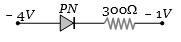
What is the current in the circuit shown below.....$amp$
  • $0$
  • B
    ${10^{ - 2}}$
  • C
    $1$
  • D
    $0.10 $

Answer

Correct option: A.
$0$
a
(a) The potential of $P-$side is more negative that of $N-$side, hence diode is in reverse biasing. In reverse biasing it acts as open circuit, hence no current flows.

Need a full question paper?

Generate a complete, print-ready paper with questions like this in minutes — across 16+ boards, with answer keys.
Start Generating Free

Similar questions

A parallel plate capacitor has two layers of dielectric as shown in figure. This capacitor is connected across a battery. The graph which shows the variation of electric field $(E)$ and distance $(x)$ from left plate.
Two coherent sources of light are placed at points $(- \frac{{5a}}{2} , 0) $ and $(+ \frac{{5a}}{2} , 0)$. Wavelength of the light is  $\lambda = \frac{{4a}}{3}$ . How many maximas will be obtained on a $CD$ planar circle of large radius with centre at origin.
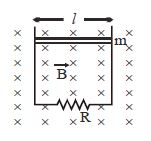
A horizontal wire is free to slide on the vertical rails of a conducting frame as shown in figure. The wire has a mass $m$ and length $l$ and the resistance of the circuit is $R$ . If a uniform magnetic field $B$ is directed perpendicular to the frame, then find the terminal speed of the wire as it falls under the force of gravity
Two unlike charges attract each other with a force of $10N.$ If the distance between them is doubled, the force between them is:
The wavelength associated with an electron accelerated through a potential difference of $100 V$ is nearly .............. $\mathop {\rm{A}}\limits^o $
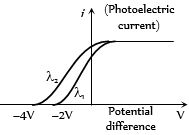
The maximum value of stopping potential in the following diagram is .......... $V$
Assertion : The resistivity of a semiconductor increases with temperature.
Reason : The atoms of a semiconductor vibrate with larger amplitude at higher temperature there by increasing it's resistivity.
What is the coordination number of sodium ions in the case of sodium chloride structure
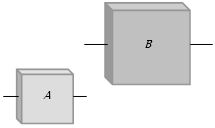
$A$ and $B$ are two square plates of same metal and same thickness but length of $B$ is twice that of $A$. Ratio of resistances of $A$ and $B$ is
In Thomson's method of determining $e/m$ of electrons