Question
What is the difference between distillation, distillation under reduced pressure and steam distillation?
| Distillation | Distillation under reduced pressure | Steam distillation |
| It is used for the purification of compounds that are associated with non-volatile impurities or those liquids, which do not decompose on boiling. In other words, distillation is used to separate volatile liquids from non-volatile impurities or a mixture of those liquids that have sufficient difference in boiling points. | This method is used to purify a liquid that tends to decompose on boiling. Under the conditions of reduced pressure, the liquid will boil at a low temperature than its boiling point and will, therefore, not decompose. | It is used to purify an organic compound, which is steam volatile and immiscible in water. On passing steam, the compound gets heated up and the steam gets condensed to water. After some time, the mixture of water and liquid starts to boil and passes through the condenser. This condensed mixture of water and liquid is then separated by using a separating funnel. |
| Mixture of petrol and kerosene is separated by this method. | Glycerol is purified by this method. It boils with decomposition at a temperature of 593K. At a reduced pressure, it boils at 453K without decomposition. | A mixture of water and aniline is separated by steam distillation. |
Generate a complete, print-ready paper with questions like this in minutes — across 16+ boards, with answer keys.
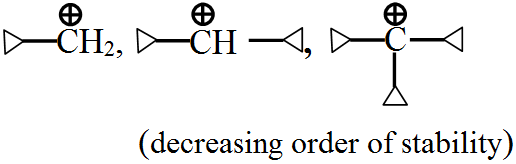
$\text{CH}_3\stackrel{\oplus \ \ \ }{\text{CH}}_2,\text{C}_6\text{H}_5-\stackrel{\oplus\ \ \ \ }{\text{CH}}_2,(\text{CH}_3)_3\stackrel{\oplus \ \ \ \ }{\text{CH}},$
$\text{CH}_2=\text{CH}-\stackrel{\oplus\ \ \ \ }{\text{CH}}_2$ (decreasing order of stability)
$\text{HC}\equiv\text{C}^{\ominus},\text{Ch}_2=\stackrel{\ominus\ \ \ \ \ \ }{\text{CH}_2},\text{CH}_3-\stackrel{\ominus\ \ \ \ \ }{\text{CH}_2},\stackrel{\ominus \ \ \ \ \ }{\text{CH}_3}$ (increasing order of stabillity)
$\text{C}_6\text{H}_5\stackrel{\bf. \ \ \ \ }{\text{CHCH}_3},\text{C}_6\text{H}_5\text{CH}_2\stackrel{\bf.\ \ \ \ \ }{\text{CH}_2},\text{C}_6\text{H}_5\stackrel{\bf.}{\text{C}}_3(\text{CH}_3)_2$ (increasing order of stabillity)
$\text{CH}_3-\stackrel{\oplus \ \ \ \ }{\text{CH}}-\text{O}-\text{CH}_3,\text{CH}_3-\stackrel{\oplus \ \ \ \ }{\text{CH}},-\text{OCH}_3,$
${\ \ \ \ \ \ \ \ \ \ \ \ \ \ \ \ \ \ \ \ \text{O}}\\{\ \ \ \ \ \ \ \\ \ \ \ \ \ \ \ \ \ \ \ \ \ \\ \|}\\\ \text{CH}_3-\stackrel{\oplus \ \ \ \ }{\text{CH}}\text{C}-\text{OCH}_3$ (decreasing order of stability)